
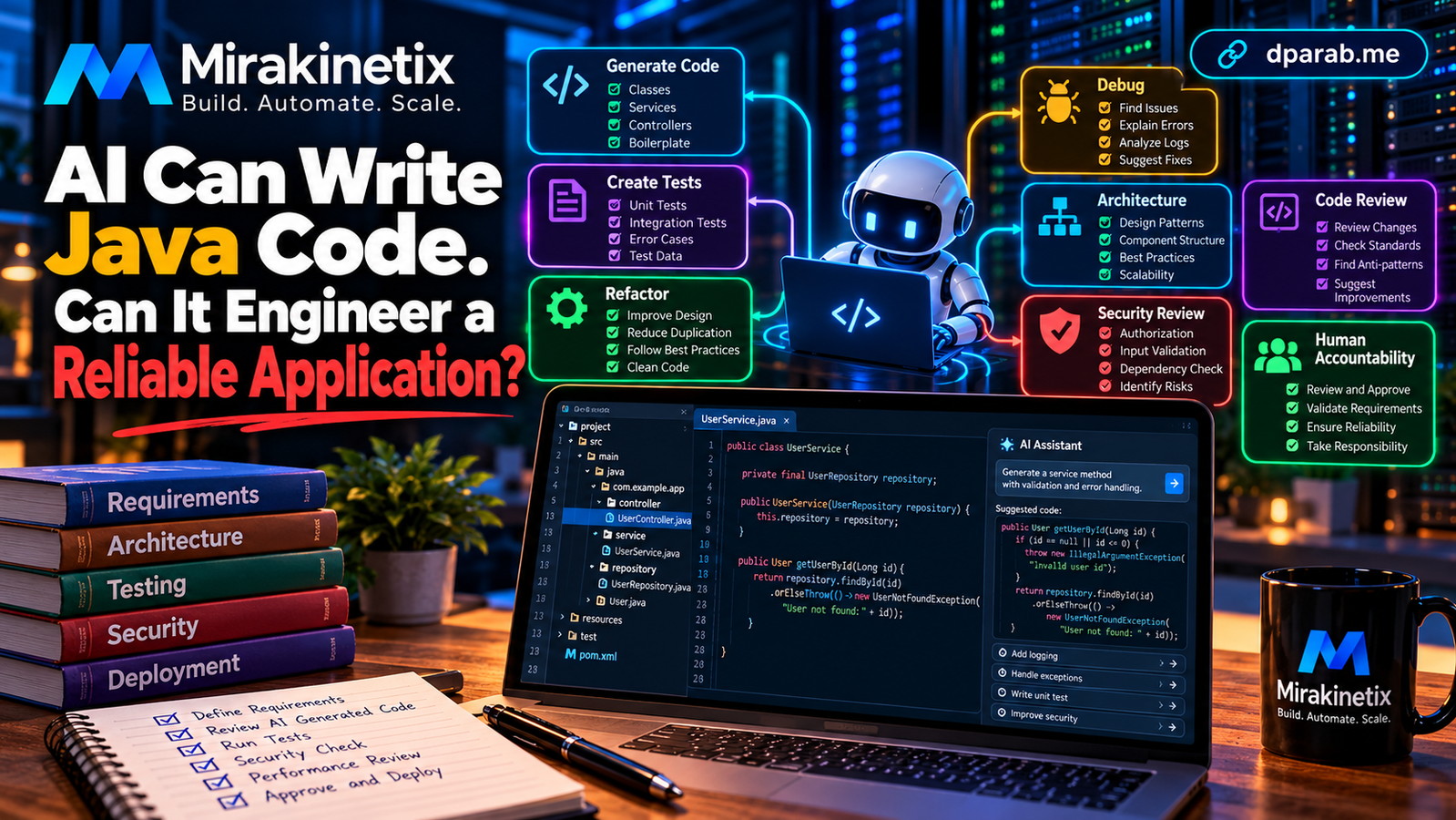
Generating Code Is Easier Than Engineering Software
AI coding assistants have changed how developers approach everyday programming. They can generate Java classes, explain unfamiliar APIs, create unit tests, suggest refactoring, and help investigate errors.
Tasks that once required significant typing can now produce a working first draft in minutes.
But there is a critical distinction: code that compiles is not necessarily code that works correctly, and code that works in a demonstration is not necessarily ready for production.
A reliable application requires more than individual methods. It needs a coherent architecture, predictable behavior, security controls, maintainable dependencies, meaningful tests, and a clear understanding of how components interact.
As AI becomes a regular part of software development, the developer's role is increasingly about directing, verifying, and taking responsibility for the resulting system.
Why AI-Generated Java Code Can Look Correct but Fail
Java's compiler catches many errors, including incompatible types and certain invalid operations. However, successful compilation cannot establish that an application satisfies its requirements.
Consider an AI-generated method that retrieves a customer's account information. The code may compile and return the expected result during testing, yet fail to check whether the requesting user is authorized to access that account.
Other problems may be less obvious:
Incorrect assumptions about business rules.
Missing validation for unexpected input.
Race conditions under concurrent requests.
Inefficient database queries that become expensive at scale.
Inadequate handling of timeouts and external service failures.
Outdated APIs or unnecessary dependencies.
Tests that verify implementation details but miss important behavior.
These are engineering problems, not merely syntax problems.
Research and industry reports published in 2026 continue to highlight the gap between AI-generated code and the verification needed before release. The OWASP DevSecOps guidance specifically recommends scrutinizing AI-generated changes for missing authorization, weak input validation, questionable dependencies, and code that the developer cannot explain. OWASP secure code review guidance.
Architecture Still Matters
An AI assistant can generate a controller, service, repository, and database model. That does not automatically mean the components belong in those locations or that their responsibilities are properly separated.
A well-designed Java application should establish clear boundaries between concerns such as:
API endpoints and request validation.
Business logic and domain rules.
Database access and persistence.
External integrations.
Configuration, logging, and error handling.
Without these boundaries, generated code can accumulate duplicated logic, tightly coupled components, and inconsistent behavior.
The problem becomes more significant when an assistant modifies an existing codebase. A locally sensible change can break a convention elsewhere in the application or bypass a control implemented in another layer.
Before asking AI to implement a feature, define the requirement, relevant architectural constraints, expected behavior, and files or interfaces that should remain unchanged. Review the proposed design before allowing a large implementation to proceed.
AI can accelerate implementation, but it should not silently determine the architecture of an entire system.
Tests Must Verify Behavior, Not Just Existence
AI tools are useful for generating tests, but generated tests can repeat the same mistaken assumptions as generated implementation code.
For example, suppose an application calculates discounts. A test that checks only a normal discount may pass even when the implementation produces incorrect results for zero-value orders, expired promotions, or conflicting discount rules.
A stronger testing strategy includes several layers:
Unit tests: Verify individual business rules and edge cases.
Integration tests: Check interactions between application components, databases, and external services.
Security tests: Check authorization, validation, data exposure, and other relevant risks.
End-to-end tests: Confirm that important user workflows behave as intended.
Regression tests: Preserve fixes for defects discovered during development or after release.
Use deterministic checks wherever possible. Compile the project, run its test suite, inspect coverage of important behavior, and run appropriate static analysis and dependency-security checks.
Passing tests provide evidence of correctness within the scenarios tested. They do not prove that every possible failure has been eliminated.
Security Cannot Be Delegated to the Model
Security is especially important because generated code can appear polished while containing a serious weakness.
An assistant might produce a database query without proper parameterization, omit an authorization check, mishandle secrets, or introduce a dependency that deserves further investigation.
AI-generated code should therefore receive at least the same scrutiny as code from an unfamiliar contributor.
A practical review should ask:
Does every sensitive operation enforce authorization?
Is untrusted input validated and handled safely?
Are credentials kept out of source code and logs?
Are dependencies legitimate, maintained, and necessary?
Could error messages expose sensitive information?
Does the change introduce an unexpected network call or permission?
Are build scripts and deployment configuration being modified safely?
Automated scanners can detect many known patterns, while human reviewers assess context and business logic. Neither approach replaces the other.
For additional guidance, see the OWASP Secure Coding with AI Cheat Sheet.
The New Bottleneck Is Verification
AI can increase the volume of code a team produces. If review, testing, and release controls remain unchanged, more code can move through the pipeline without enough scrutiny.
This creates a verification bottleneck.
The solution is not to abandon AI assistance. It is to build a workflow that matches its speed with reliable checks:
Define a small, testable requirement.
Ask the assistant to explain its proposed approach.
Generate or modify a limited set of components.
Review the diff and understand every consequential change.
Run automated tests, static analysis, and dependency checks.
Investigate failures rather than asking AI to suppress them.
Require appropriate approval before merging and deploying.
For coding agents that can execute commands or modify files, apply least privilege. Use isolated development environments, restrict access to production credentials, and require approval for sensitive operations.
The objective is not to inspect every character manually. It is to make sure that important behavior is tested, security-sensitive decisions are reviewed, and every change has an accountable owner.
Developers Remain Responsible
One of the most dangerous responses to a defect is to say, "The AI wrote that code."
The tool may have generated the implementation, but the engineering team decides whether to accept, merge, and deploy it.
Developers need to understand what the code does, why the chosen approach is appropriate, how failures are handled, and what evidence supports its correctness.
This also changes what effective software engineering looks like. Typing speed matters less when code generation is fast. Requirements analysis, architectural judgment, debugging, security awareness, testing, and the ability to challenge an incorrect answer become even more valuable.
The best developers will not necessarily be those who generate the most code. They will be those who use AI to reduce repetitive work without sacrificing engineering discipline.
Build Faster Without Lowering the Standard
AI-assisted development is a meaningful shift in software engineering, including Java development. It can help teams explore unfamiliar APIs, accelerate routine implementation, improve documentation, and investigate defects.
However, productivity gains are valuable only when the resulting software remains dependable.
At Mirakinetix, the principle behind building practical software remains straightforward: technology should help us build, automate, and scale without losing control over quality.
Use AI as an implementation assistant, not as a substitute for engineering judgment. Let automation handle repeatable checks, use tests to verify behavior, review security-sensitive changes carefully, and keep human accountability at the center of the delivery process.
AI can write Java code. Building a reliable application still requires engineering.


