
API-First Architecture: Designing Systems That Scale
Introduction
If you're building software today, there is a good chance your application will eventually need to talk to something else.
A web frontend may need the same backend as a mobile application. An internal dashboard may need access to the same data as a customer portal. A payment provider may need to send events back to your application. A third-party service may need access to selected functionality. An AI agent may eventually need to consume the same capabilities through an API.
This is where many applications run into trouble.
Developers often build the application first and expose APIs later. At the beginning, this seems perfectly reasonable. The application works, the database is connected, and the features are delivered.
Then the requirements grow.
A mobile app needs the same functionality. A partner needs integration access. Another frontend is introduced. Suddenly, business logic is tightly coupled to controllers, views, database queries, or a particular user interface.
What started as a simple application becomes difficult to extend without breaking something.
API-first architecture addresses this problem by treating the API as a first-class part of the system—not as an afterthought.
Instead of asking:
"How do we expose our existing application through an API?"
API-first development asks:
"What capabilities should our system expose, how should consumers interact with them, and what contract should exist between them?"
That shift has significant implications for how developers design applications.
API-first architecture is not simply about creating REST endpoints. It is about establishing clear boundaries between consumers and the application, separating business logic from presentation, defining stable contracts, and creating a foundation that can evolve as the system grows.
What Is API-First Architecture?
API-first architecture means designing and defining the application's APIs before implementing the underlying functionality.
The API becomes a contract between the system and its consumers.
For example, imagine an e-commerce platform.
Instead of building a web application and later creating APIs for a mobile application, an API-first approach starts by defining the capabilities that both applications need.
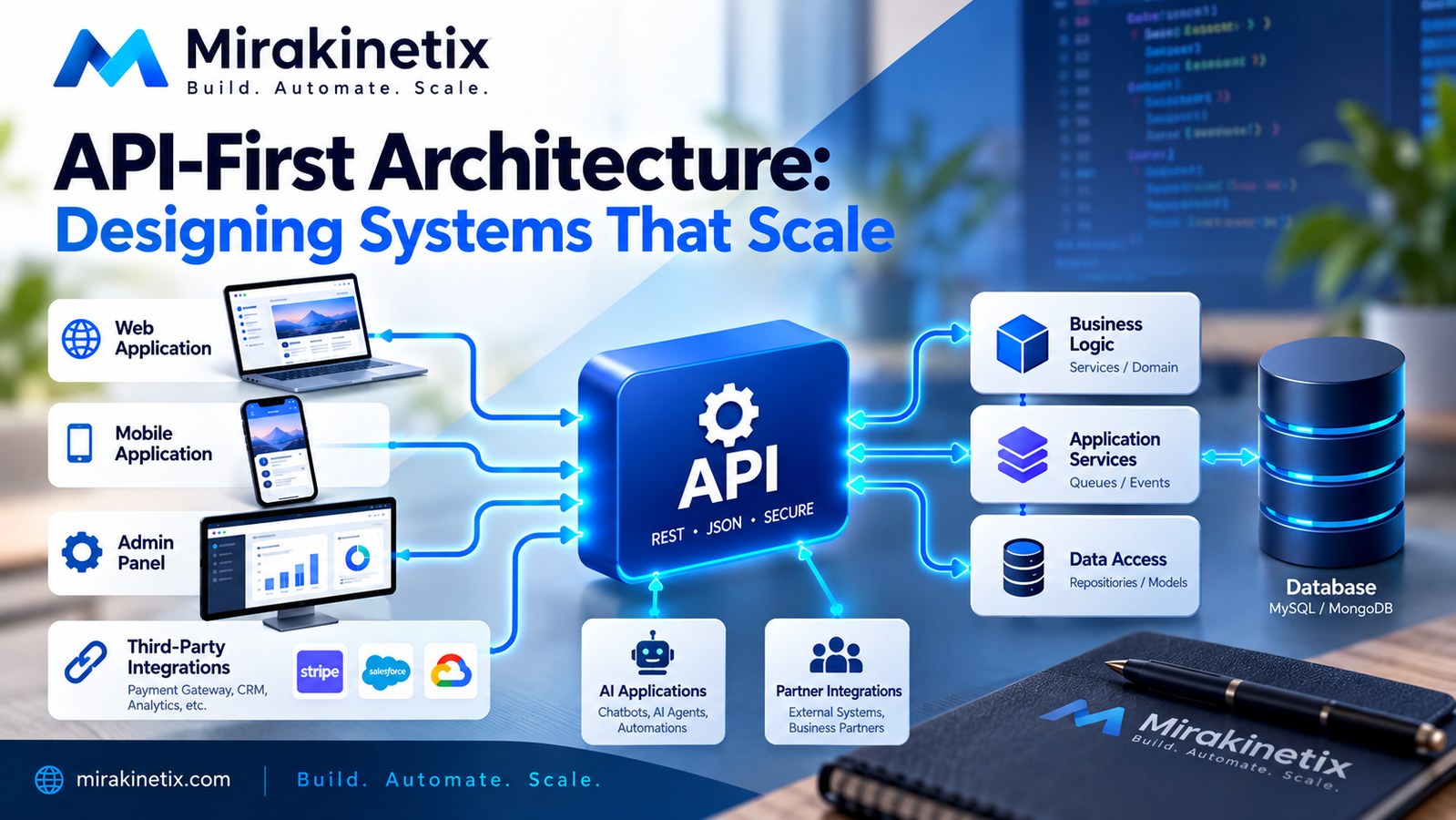
A simplified architecture might look like this:
Web Application → API → Business Logic → Database
Mobile Application → API → Business Logic → Database
Third-Party Integration → API → Business Logic → Database
The web application, mobile application, and external systems can consume the same core capabilities.
This creates a cleaner separation between the user interface and the underlying business logic.
APIs Are Contracts
One of the most important ideas behind API-first development is the concept of a contract.
An API contract defines things such as:
Available endpoints
Request parameters
Authentication requirements
Request formats
Response formats
Error responses
HTTP methods
Status codes
Versioning rules
For example:
GET /api/v1/customers/123
might return:
{
    "id": 123,
    "name": "John Doe",
    "email": "john@example.com"
}
The consumer doesn't need to know how the customer information is stored internally.
It only needs to understand the API contract.
That separation is extremely powerful.
Why API-First Matters
Businesses increasingly operate across multiple platforms.
A company may have:
A public website
A mobile application
An internal administration system
A customer portal
Partner integrations
Automated processes
AI-powered applications
If every application implements its own business logic independently, the system becomes difficult to maintain.
API-first architecture provides a common interface through which these applications can interact with the underlying platform.
This can reduce duplication and make future integrations easier.
Design the API Before Writing the Code
One of the biggest advantages of API-first development is that teams can discuss the interface before implementation begins.
Developers, frontend engineers, mobile developers, architects, and other stakeholders can agree on how the system should behave.
For example:
POST /api/v1/orders
could define:
{
    "customer_id": 123,
    "items": [
        {
            "product_id": 456,
            "quantity": 2
        }
    ]
}
The response could then be defined before the backend implementation exists.
This allows different teams to work in parallel.
The frontend team can build against the agreed contract while backend developers implement the underlying services.
API-First Does Not Mean Microservices
This distinction is important.
API-first architecture and microservices are not the same thing.
You can build an API-first monolithic application.
For example:
                ┌── Web Application
                │
                ├── Mobile Application
Clients ────────┼── Admin Panel
                │
                └── External Integrations
                        │
                        ▼
                   API Layer
                        │
                        ▼
                Monolithic Application
                        │
                        ▼
                     Database
The backend may still be a single Laravel application.
The important part is that the API provides a clearly defined interface between consumers and the application.
Microservices are a separate architectural decision.
API-First and Laravel
Laravel is well suited to API-driven application development.
A Laravel application can expose RESTful endpoints while keeping business logic separated from controllers.
A simplified structure might look like:
Request
   ↓
Route
   ↓
Controller
   ↓
Service
   ↓
Repository / Model
   ↓
Database
The controller should not become the place where every business rule is implemented.
Instead, controllers can focus on handling HTTP concerns while application services contain business logic.
This makes the system easier to test and maintain.
Authentication and Authorization
A production API needs more than endpoints.
Authentication determines who is making a request.
Authorization determines what that user or application is allowed to do.
These are different concerns.
For example:
Authenticated User
        ↓
Can access customer?
        ↓
Can modify customer?
        ↓
Can delete customer?
An API should verify permissions at every sensitive operation.
Never assume that because a user can access one endpoint, they should automatically have access to every related resource.
API Versioning
APIs often live for years.
Once external applications depend on an API, changing its behavior can break those applications.
Versioning provides a mechanism for evolving the API while maintaining compatibility.
A simple approach is:
/api/v1/customers
/api/v2/customers
Versioning doesn't mean every small change requires a new API version.
The important principle is to avoid unexpectedly breaking existing consumers.
Changes should be deliberate and documented.
Consistent Error Handling
Successful API responses get most of the attention, but error responses are equally important.
Consumers need predictable errors.
For example:
{
    "error": {
        "code": "VALIDATION_ERROR",
        "message": "The request contains invalid data.",
        "fields": {
            "email": [
                "The email address is invalid."
            ]
        }
    }
}
A consistent error structure makes APIs easier to consume and debug.
HTTP status codes should also communicate the general result of the request appropriately.
API Documentation Is Part of the Product
An API without good documentation becomes difficult to use.
Documentation should explain:
Authentication
Endpoints
Request parameters
Request examples
Response examples
Error responses
Rate limits
Versioning
Deprecation policies
Tools based on the OpenAPI specification can help teams describe APIs in a machine-readable format.
Good documentation also reduces the amount of time developers spend asking how an API works.
Security Should Be Designed From the Beginning
An API is an attack surface.
Security should therefore be part of the architecture rather than something added after development.
Important considerations include:
Authentication
Authorization
Input validation
Rate limiting
Secure secret management
Transport encryption
Logging
Monitoring
Protection against injection attacks
Protection against excessive data exposure
APIs should return only the information consumers actually need.
Returning an entire database record simply because it is convenient can expose unnecessary information.
Observability Matters
As API traffic grows, debugging becomes more difficult.
A production API should provide useful observability.
This can include:
Request logs
Application logs
Error tracking
Response-time monitoring
Metrics
Health checks
Distributed tracing where appropriate
Alerts
For example, if API response times suddenly increase, monitoring should help identify whether the problem is related to:
Database queries
External APIs
Application code
Network latency
Resource exhaustion
Without observability, diagnosing production problems becomes much harder.
APIs and Scalability
An API doesn't automatically make an application scalable.
However, a well-designed API can provide a clean boundary between consumers and backend systems.
That boundary makes it easier to introduce improvements later.
For example:
Clients
   ↓
Load Balancer
   ↓
API Servers
   ↓
Cache / Queue
   ↓
Database
Multiple API servers can process requests while sharing the underlying infrastructure.
Caching can reduce repeated database queries.
Queues can move long-running operations outside the request-response cycle.
Database optimization can improve data access.
The API becomes the stable interface while the underlying implementation evolves.
Avoid Overengineering
API-first architecture does not mean every application needs dozens of services, event buses, message brokers, and distributed databases.
A small application may only need a well-structured Laravel API and a MySQL database.
Architecture should match the actual requirements of the system.
Start with clear boundaries.
Keep the system simple.
Introduce additional infrastructure when there is a demonstrated need for it.
Complexity should solve a problem, not create one.
Build for Consumers You Have Today—and Tomorrow
A good API should solve today's requirements without unnecessarily restricting tomorrow's possibilities.
For example, if an API is designed only around the requirements of a single frontend, it may become tightly coupled to that frontend.
A better API exposes meaningful business capabilities.
Instead of:
GET /api/getHomepageData
consider APIs based on actual resources and business operations:
GET /api/v1/products
GET /api/v1/customers
GET /api/v1/orders
POST /api/v1/orders
The second approach creates a clearer foundation for future consumers.
Final Thoughts
API-first architecture is fundamentally about designing boundaries.
The API becomes a contract between the system and the applications that depend on it.
When designed properly, it can make systems easier to integrate, test, scale, maintain, and evolve.
But API-first does not mean building the most complicated architecture possible.
A well-designed monolith with a clean API can be a better solution than an unnecessarily complex collection of microservices.
The important questions are:
What capabilities does the business need to expose?
Who will consume them?
What contract should exist between those consumers and the system?
How can that contract remain stable while the implementation evolves?
Answer those questions first.
Then choose the technology and infrastructure needed to support them.


