
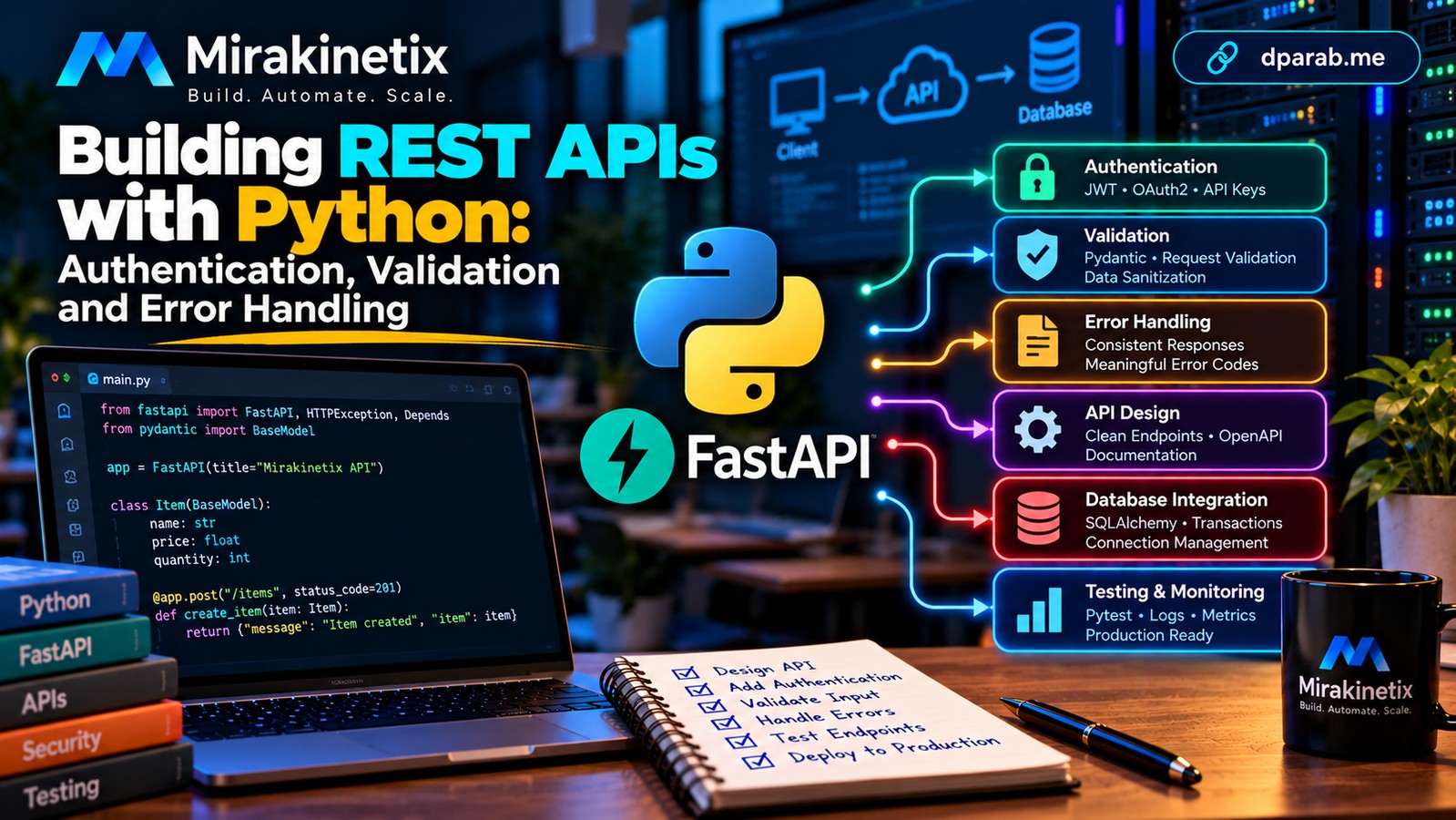
A REST API is often the foundation of a modern application. It connects web frontends, mobile applications, internal services, databases, and third-party integrations.
However, a working endpoint is not necessarily a production-ready API. Authentication, authorization, input validation, error handling, database transactions, and monitoring determine whether an API remains secure and reliable under real-world conditions.
For backend developers, senior engineers, and technical leads, Python's FastAPI framework provides a practical way to build structured APIs without sacrificing development speed.
1. Choose the Right Python Framework
Python offers several web frameworks, but two common choices are Django REST Framework and FastAPI.
Django REST Framework is suitable when you need Django's ORM, authentication ecosystem, administration capabilities, and a mature structure for data-driven applications.
FastAPI is well suited to API-first services. It uses Python type hints, supports request validation through Pydantic, generates OpenAPI documentation, and supports asynchronous endpoints.
For this tutorial, we will use FastAPI.
Install the required packages:
pip install fastapi uvicornStart a development server:
uvicorn main:app --reloadThe --reload option is intended for development, not production deployment.
2. Define a Clear API Contract
Before implementing endpoints, decide what the API accepts and returns.
For example, a product API might expose:
GET /products— list products.GET /products/{product_id}— retrieve one product.POST /products— create a product.PATCH /products/{product_id}— update selected fields.DELETE /products/{product_id}— delete a product.
Use appropriate HTTP methods and status codes. Return 201 Created after successful creation, 404 Not Found for a missing resource, and 422 Unprocessable Entity when FastAPI rejects invalid request data.
Consistent contracts make APIs easier to test, document, and integrate with other systems.
3. Validate Input at the Boundary
Never assume that incoming JSON is valid simply because your frontend validates it.
FastAPI uses Pydantic models to validate request data.
from fastapi import FastAPI
from pydantic import BaseModel, Field

app = FastAPI()

class ProductCreate(BaseModel):
    name: str = Field(min_length=2, max_length=100)
    price: float = Field(gt=0)
    quantity: int = Field(ge=0)

@app.post("/products", status_code=201)
def create_product(product: ProductCreate):
    return {
        "name": product.name,
        "price": product.price,
        "quantity": product.quantity
    }
The framework validates the request against the model before calling the endpoint.
In a real application, also consider currency precision, permitted characters, business rules, maximum payload sizes, and relationships between fields.
Validation protects the application's boundaries. Business rules must still be enforced by the appropriate service or domain layer.
4. Authentication Is Different From Authorization
Authentication establishes who is making a request. Authorization determines what that identity is allowed to do.
An authenticated customer should not automatically be able to retrieve every other customer's orders.
For production APIs, common authentication approaches include:
OAuth 2.0 or OpenID Connect for delegated access and identity integration.
Short-lived access tokens for API clients.
Secure session-based authentication where appropriate.
Service identities and scoped credentials for internal integrations.
FastAPI supports OAuth2-related security utilities, but configuring a token scheme does not automatically provide a complete identity system. Token issuance, signature verification, expiration, audience, issuer, and permission checks must be implemented correctly or delegated to a trusted identity provider.
Avoid inventing a custom cryptographic token format when established standards meet the requirement.
5. Protect Resources With Authorization Checks
Consider an endpoint that returns an order.
The API should verify both that the caller is authenticated and that the caller may access the requested order.
A typical authorization flow is:
Validate the access token.
Establish the authenticated identity.
Load the requested order.
Check ownership or the required permission.
Return only the authorized data.
Use role-based permissions or resource-level policies as appropriate. For example, an administrator may have broader access than a customer, while a support agent may have limited access governed by explicit rules.
Do not trust a customer_id supplied in the request body to establish ownership. Derive identity from the authenticated principal and verify access on the server.
6. Handle Errors Consistently
Uncontrolled exceptions can expose internal details and produce confusing responses.
FastAPI provides HTTPException for expected HTTP errors:
from fastapi import HTTPException

@app.get("/products/{product_id}")
def get_product(product_id: int):
    product = None  # Replace with a database lookup.

    if product is None:
        raise HTTPException(
            status_code=404,
            detail="Product not found"
        )

    return product
In a production application, centralize exception handling where appropriate and use a consistent error structure. Include a stable error code, a safe message, and a request or correlation ID when useful.
Never return database credentials, SQL statements, stack traces, access tokens, or internal infrastructure details to clients.
Log diagnostic information securely on the server, where access can be controlled.
7. Integrate the Database Carefully
An API that works with an in-memory example is only a starting point. Production services need durable storage and predictable transaction behavior.
A clean architecture separates responsibilities:
Router: handles HTTP requests and responses.
Schema: validates request and response data.
Service: applies business rules.
Repository or data-access layer: manages persistence.
Database: stores durable application state.
Use parameterized queries or a properly configured ORM to prevent SQL injection. Apply database transactions when multiple operations must succeed or fail together.
Avoid performing expensive database operations directly inside a request handler without considering query performance, connection management, and concurrency.
For asynchronous endpoints, ensure database access libraries and operations are compatible with the chosen execution model.
8. Test More Than the Happy Path
A successful request proves very little about an API's reliability.
Test:
Valid and invalid request bodies.
Missing, expired, or invalid credentials.
Unauthorized resource access.
Missing records.
Duplicate submissions.
Database failures and transaction rollback.
Rate limits and oversized requests.
Unexpected exceptions.
FastAPI integrates with Python testing tools such as pytest and provides TestClient for endpoint tests.
Tests should verify both HTTP status codes and response content. Security tests should also confirm that one user's identity cannot be used to access another user's private resources.
9. Add Rate Limiting and Operational Controls
Public APIs can be abused through repeated requests, credential attacks, or expensive operations.
Apply rate limits at the API gateway, reverse proxy, or application layer based on the threat model. Login attempts, password recovery, report generation, and costly search operations may need different limits.
In distributed deployments, an in-memory counter in one application process is generally insufficient for a global limit. Use a shared mechanism or gateway-level controls when limits must apply across multiple instances.
Production deployment should also include:
HTTPS and secure secret management.
Request and response size limits.
Connection and execution timeouts.
Structured logs and error tracking.
Health checks and performance metrics.
Dependency updates and security testing.
Database backups and recovery procedures.
10. A Practical Production Architecture
A typical deployment looks like this:
Client → HTTPS reverse proxy or API gateway → FastAPI application → service layer → database
Supporting components may include Redis for appropriate caching or shared rate-limit state, a queue for long-running background jobs, and centralized monitoring for logs, metrics, and traces.
Keep long-running work out of synchronous request paths when it can be processed safely in the background. Define retry limits and idempotency rules so repeated requests do not accidentally create duplicate orders or payments.
Scale application instances only after identifying the actual bottleneck, and ensure that shared state, database capacity, and background workers can support the additional traffic.
Common Mistakes to Avoid
Treating authentication as proof of authorization.
Trusting client-supplied ownership identifiers.
Returning raw exception details to users.
Putting all business logic into route handlers.
Ignoring transaction boundaries.
Retrying operations without considering duplicate side effects.
Deploying development servers directly to production.
Monitoring server uptime while ignoring API latency and error rates.
Final Thoughts
Building a reliable Python REST API requires more than choosing a framework. It requires clear contracts, validated input, strong identity and permission checks, predictable errors, safe database operations, automated tests, and production observability.
FastAPI can accelerate development, but sound engineering practices determine whether the resulting service is secure, maintainable, and ready to scale.
Mirakinetix helps businesses build, automate, and scale reliable software systems. Visit dparab.me for practical engineering insights and Mirakinetix for software architecture, automation, performance optimization, and application security.
Build. Automate. Scale.


