
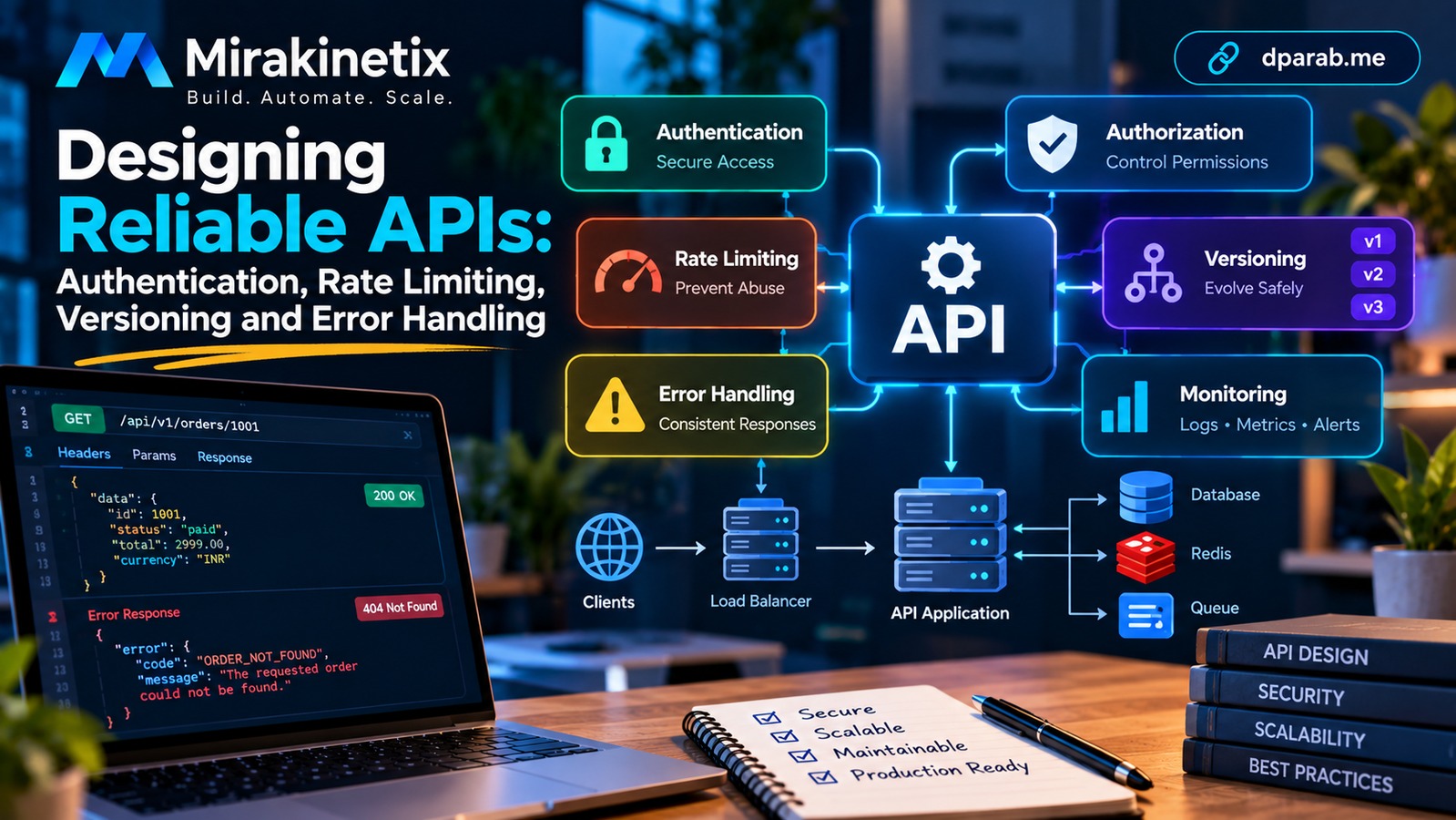
An API can be technically functional and still be unreliable in production.
Returning the correct JSON response is only one part of API engineering. A production API also needs authentication, authorization, validation, rate limiting, versioning, predictable errors, monitoring, and a strategy for handling failures.
This guide is for backend developers, senior engineers, technical leads, architects, and engineering teams building APIs that need to remain maintainable as users, integrations, traffic, and business requirements grow.
Start With a Clear API Contract
A reliable API begins with a predictable contract.
For example:
GET /api/v1/orders/1001
A client should know:
What authentication is required
What parameters are accepted
What response structure is returned
Which HTTP status codes are possible
What errors look like
What happens when the resource does not exist
Consistency is more valuable than cleverness.
If one endpoint returns 404 for a missing resource while another returns 200 with an empty object, clients have to implement unnecessary special cases.
Authentication and Authorization Are Different
Authentication answers:
Who are you?
Authorization answers:
Are you allowed to perform this action?
An authenticated user should not automatically have access to every resource.
For example:
GET /api/v1/orders/1001
The application may authenticate the user successfully but still need to verify that the user is allowed to access order 1001.
A secure request flow is:
Request → Authentication → Authorization → Validation → Business Logic → Response
Do not rely on hidden frontend controls for authorization.
The server must enforce access.
Validate Input at the Boundary
Never assume API input is trustworthy.
Validate:
Required fields
Data types
String lengths
Numeric ranges
Enumerated values
Resource identifiers
Business constraints
For example:
$request->validate([
    'product_id' => ['required', 'integer'],
    'quantity' => ['required', 'integer', 'min:1', 'max:100'],
]);
Validation should happen before business logic processes the data.
This reduces unexpected states and makes failures easier to understand.
Use Rate Limiting
Even a properly authenticated API can be abused.
Rate limiting helps protect APIs from:
Brute-force attempts
Accidental request loops
Scraping
Excessive API consumption
Expensive operations
Denial-of-service pressure
Not every endpoint needs the same limit.
For example:
Login API       → strict limit
Public API      → moderate limit
Normal user API → user-based limit
Reports         → very strict limit
Internal API    → controlled service limit
Rate limiting should be designed according to the cost and sensitivity of the operation.
Version Your APIs
APIs often live longer than the applications that created them.
Once external clients depend on an API, changing its behavior can become expensive.
A common approach is:
/api/v1/orders
/api/v2/orders
Versioning gives teams room to introduce breaking changes without immediately breaking existing consumers.
However, versioning should not become an excuse for poor API design.
Avoid creating a new version for every minor change.
A new version is generally more appropriate when the contract changes in a way that existing clients cannot safely handle.
Design Consistent Responses
Clients should not have to guess the structure of every response.
A successful response might look like:
{
  "data": {
    "id": 1001,
    "status": "paid"
  }
}
An error should also have a predictable structure:
{
  "error": {
    "code": "ORDER_NOT_FOUND",
    "message": "The requested order could not be found."
  }
}
The exact structure can vary between systems.
What matters is consistency.
Avoid returning raw exception messages, database errors, stack traces, or internal implementation details to clients.
Use HTTP Status Codes Properly
HTTP status codes communicate important information.
Common examples include:
200 OK— successful request201 Created— resource created204 No Content— successful request without response content400 Bad Request— malformed or invalid request401 Unauthorized— authentication required or failed403 Forbidden— authenticated but not permitted404 Not Found— resource not found409 Conflict— request conflicts with current state422 Unprocessable Content— validation failure429 Too Many Requests— rate limit exceeded500 Internal Server Error— unexpected server failure503 Service Unavailable— service temporarily unavailable
Using meaningful status codes makes APIs easier to integrate and monitor.
Handle Errors Deliberately
Failures are normal in distributed systems.
A database can become unavailable.
A third-party payment service can time out.
A queue can become delayed.
An external API can return an unexpected response.
The API should handle these situations deliberately.
For external services, consider:
Connection timeouts
Response timeouts
Limited retries
Exponential backoff
Circuit-breaking strategies
Fallback behavior
Structured logging
Do not blindly retry every failure.
A retry can make an outage worse if thousands of requests immediately repeat the same failing operation.
Make Operations Idempotent
Idempotency becomes particularly important for APIs handling payments, orders, registrations, or other state-changing operations.
Imagine a client sends:
POST /api/v1/payments
The server processes the payment, but the network connection fails before the client receives the response.
The client may retry.
Without protection, the payment could potentially be processed twice.
An idempotency key can allow the server to recognize that the request has already been processed.
Idempotency-Key: 8f4d-1234-payment
This is an important production consideration for operations where duplicate execution has serious consequences.
Monitor API Health
An API is not reliable simply because it returns 200 OK.
Monitor:
Request volume
Response latency
Error rate
4xxresponses5xxresponsesRate-limit events
Database latency
Queue delays
External API failures
Resource utilization
Track latency using percentiles such as p95 and p99, not just averages.
An average response time can look healthy while a significant percentage of users experience very slow requests.
Example Production Architecture
A practical architecture might look like:
Client
   ↓
Load Balancer
   ↓
API Application
   ↓
Authentication / Authorization
   ↓
Validation
   ↓
Application Services
   ↓
 ┌───────────┬───────────┬────────────┐
 ↓           ↓           ↓
MySQL       Redis       Queue
                         ↓
                  Background Workers
                         ↓
                  External Services
Monitoring and centralized logging should operate across the system.
This architecture can work with Laravel, Spring Boot, Python, or other backend technologies.
The principles remain largely the same.
Laravel Example
A Laravel API can combine authentication, authorization, validation and resource responses:
public function show(Order $order)
{
    $this->authorize('view', $order);

    return new OrderResource($order);
}
The route can then apply authentication and rate-limiting middleware:
Route::middleware(['auth:sanctum', 'throttle:api'])
    ->get('/orders/{order}', [OrderController::class, 'show']);
The important point is not the exact framework syntax.
The important point is that security and reliability controls should be part of the API architecture rather than added after problems appear.
Common API Design Mistakes
No Authentication Strategy
Leaving authentication decisions until late creates architectural problems.
Authentication Without Authorization
Knowing who the user is does not mean the user can access every resource.
No Rate Limiting
Public or expensive endpoints can become abuse targets.
Breaking Clients Without Versioning
Changing an existing response contract can break integrations unexpectedly.
Inconsistent Errors
Different error structures increase integration complexity.
Returning Internal Errors
Database messages and stack traces should never become public API responses.
Retrying Everything
Uncontrolled retries can amplify an outage.
No Observability
If you cannot see latency, failures and traffic patterns, diagnosing production problems becomes difficult.
A Practical API Reliability Checklist
Before releasing an API, verify:
Authentication is implemented.
Authorization is enforced server-side.
Input is validated.
Sensitive endpoints are rate limited.
API contracts are documented.
Breaking changes have a versioning strategy.
Responses are consistent.
Errors use meaningful status codes.
Internal errors are not exposed.
External calls have timeouts.
Retries are controlled.
Important operations support idempotency where necessary.
Logs contain useful request and error information.
Metrics and health checks are available.
Database and queue performance are monitored.
Final Thoughts
Reliable APIs are built through disciplined engineering rather than a single framework feature.
Authentication protects identity. Authorization protects access. Validation protects application boundaries. Rate limiting protects resources. Versioning protects clients. Error handling protects reliability. Monitoring tells you what is actually happening in production.
The technology stack may change, but these principles remain relevant.
Whether you are building a Laravel API, a Spring Boot service, or a Python backend, design the API as a long-term contract between systems.
Build the contract carefully. Protect it. Monitor it. And design for failure before production teaches you the hard way.
Build Reliable APIs With Mirakinetix
If your business needs a new API, application integration, automation workflow, or backend system, Mirakinetix can help design and build it with production reliability in mind.
From Laravel and PHP applications to API integrations, databases, queues, authentication, security, and scalable backend architecture, the focus is on building systems that are maintainable today and ready to grow tomorrow.
Have an application or business process that needs a reliable backend? Let's build it properly.
Mirakinetix — Build. Automate. Scale.


