
Becoming a senior developer is often about becoming exceptionally good at solving technical problems.
Becoming an engineering leader is different.
At some point, the question changes from:
“How do I solve this problem?”
to:
“How do I help the team solve the right problems effectively?”
That shift is one of the biggest transitions in an engineering career.
Technical expertise still matters. But leadership introduces a much broader set of responsibilities: architecture, prioritization, communication, mentoring, risk management, delivery, and business context.
The Senior Developer Mindset
A strong senior developer can usually take ownership of complex technical problems.
They understand:
Application architecture
Databases
APIs
Performance
Security
Testing
Deployment
Debugging
Technical trade-offs
They can work independently and make sound technical decisions.
But leadership requires expanding that perspective.
Instead of focusing only on your own output, you start thinking about the output of the entire engineering system.
That includes people, processes, technology, and priorities.
Stop Measuring Your Value by Lines of Code
One of the hardest adjustments for experienced developers is accepting that writing less code can sometimes create more value.
As a senior engineer, you may solve a problem yourself in two hours.
As a leader, you might spend those two hours:
Clarifying requirements
Removing a blocker
Reviewing an architectural decision
Mentoring another engineer
Improving documentation
Automating a repetitive process
Preventing a future production incident
You may personally produce fewer lines of code.
The organization can nevertheless become significantly more productive.
That is an important leadership transition.
Technical Leadership Does Not Mean Abandoning Technology
Engineering leadership does not require becoming disconnected from technology.
A technical leader should still understand the systems their team builds.
You should be able to discuss:
Architecture
Scalability
Security
Databases
APIs
Infrastructure
Reliability
Technical debt
Development practices
The difference is that you are no longer expected to personally implement every important decision.
Your role increasingly becomes creating the conditions for good technical decisions to happen consistently.
Learn to Make Trade-Offs
Engineering decisions rarely have perfect answers.
You may need to choose between:
Speed and maintainability
Simplicity and flexibility
Cost and performance
Delivery deadlines and technical debt
Custom development and third-party services
Immediate fixes and long-term solutions
Good leadership does not mean eliminating trade-offs.
It means making them explicit.
For example, choosing a simple Laravel monolith for a new application may be entirely reasonable if the team is small and the requirements are straightforward.
Introducing several microservices on day one may add operational complexity without solving an actual problem.
Architecture should serve the business rather than impress the engineering team.
Learn to Communicate With Different Audiences
Developers often communicate in technical terms.
Engineering leaders need to communicate with many different groups.
A developer may ask:
“Which database should we use?”
A product manager may ask:
“Can we launch this feature next month?”
A business leader may ask:
“What will this investment enable?”
A customer may simply ask:
“Why is the system unavailable?”
The underlying technical reality may be the same.
The explanation needs to change depending on the audience.
Clear communication is therefore not a soft skill sitting outside engineering.
It is part of engineering leadership.
Mentoring Is a Force Multiplier
A senior engineer who solves difficult problems personally can have significant impact.
A leader who teaches several engineers how to solve similar problems can multiply that impact.
Mentoring can include:
Code reviews
Architecture discussions
Pair programming
Technical documentation
Design reviews
Career guidance
Debugging sessions
Knowledge-sharing sessions
The objective is not to create engineers who think exactly like you.
The objective is to help engineers develop the ability to make good decisions independently.
Delegate Outcomes, Not Just Tasks
There is a major difference between delegation and task assignment.
Task assignment sounds like:
“Implement this API endpoint.”
Outcome-based delegation sounds more like:
“We need this service to support reliable payment status updates. Design and implement the approach, and explain the trade-offs.”
The second approach gives an engineer ownership of the problem.
That does not mean disappearing after assigning it.
Good delegation includes clear expectations, appropriate support, and useful checkpoints.
Code Reviews Should Improve the System
Code review can easily become a battle over personal preferences.
A productive review focuses on things that matter:
Correctness
Security
Maintainability
Performance
Test coverage
Architecture
Operational impact
Not every difference needs to become a debate.
If two approaches are both reasonable, the review may not need to block the change.
Engineering leadership means knowing which decisions deserve deep discussion and which ones do not.
Think About Technical Debt Differently
Technical debt is unavoidable.
Not all technical debt is bad.
Sometimes a team deliberately chooses a simpler implementation to meet an important deadline.
The problem occurs when technical debt becomes invisible.
A leader should understand:
Why the debt exists
What risk it creates
When it needs attention
What it will cost to remove
Whether it is blocking future development
Technical debt should be managed like a business trade-off rather than treated as a moral failure.
Production Ownership Changes Everything
Writing code in development is only one part of engineering.
A leader should also care about what happens after deployment.
That includes:
Monitoring
Logging
Alerts
Backups
Security
Incident response
Performance
Capacity
Disaster recovery
A feature is not truly finished simply because it works on a developer's machine.
Engineering leadership requires thinking about the complete lifecycle of the system.
Learn to Prioritize
There will always be more engineering work than available time.
You cannot fix everything simultaneously.
A useful prioritization process considers:
Business impact
Customer impact
Security risk
Reliability risk
Technical dependencies
Engineering effort
Time sensitivity
A critical security vulnerability may deserve attention before an attractive product enhancement.
A production reliability problem may deserve attention before a minor refactoring project.
Leadership means making those priorities visible.
Protect the Engineering Team From Unnecessary Noise
Engineers need uninterrupted time to solve difficult problems.
Constantly changing priorities, unnecessary meetings, unclear requirements, and excessive interruptions can reduce productivity.
An engineering leader should help create an environment where developers can focus.
That can mean:
Clarifying requirements before development
Reducing unnecessary meetings
Protecting focused work
Resolving cross-team dependencies
Establishing clear priorities
Escalating important blockers
Leadership is not just assigning work.
Sometimes it means preventing unnecessary work from reaching the team.
Measure Outcomes, Not Activity
It is easy to measure:
Number of commits
Number of tickets
Hours worked
Lines of code
Number of pull requests
These measurements do not necessarily represent business value.
More useful questions include:
Did reliability improve?
Did deployment become safer?
Did customers receive the feature?
Did performance improve?
Did incidents decrease?
Did development become easier?
Did the team become more capable?
Activity tells you what happened.
Outcomes tell you whether it mattered.
Stay Technical While Thinking Strategically
One of the strongest combinations in engineering leadership is technical depth plus strategic thinking.
You should be able to move between different levels of abstraction.
For example:
Low level:
Why is this SQL query slow?
System level:
Why is database load increasing?
Architecture level:
Should this workload be moved to a queue or read replica?
Business level:
What customer or business capability does this optimization enable?
The ability to move between these levels becomes increasingly valuable as responsibility grows.
Leadership Does Not Mean Having Every Answer
A common mistake is believing that an engineering leader must always be the smartest person in the room.
That is not sustainable.
Good leaders know when to say:
“I don't know. Let's investigate.”
They ask questions.
They listen.
They bring the right people into the discussion.
They encourage engineers to challenge assumptions.
The goal is not to demonstrate that you have every answer.
The goal is to help the team arrive at good answers.
Build Systems That Outlast Individuals
A mature engineering organization should not depend on one person knowing everything.
Document:
Architecture
Deployment procedures
Operational runbooks
Security practices
Important technical decisions
Database dependencies
Service ownership
Recovery procedures
If only one engineer knows how production works, the organization has a risk.
Good leadership turns individual knowledge into organizational capability.
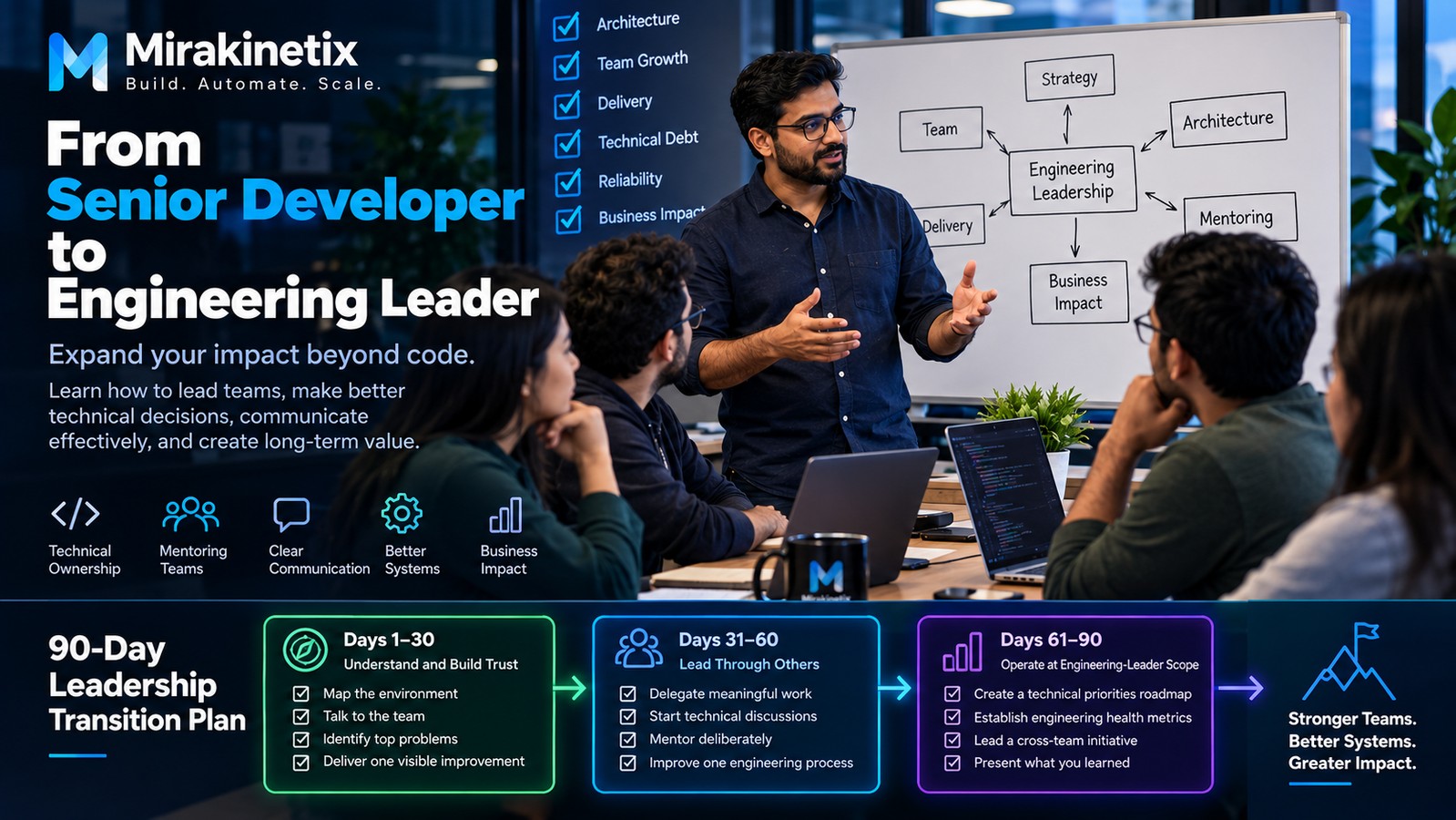
A Concrete 90-Day Leadership Transition Plan
You do not need to wait for an engineering manager title to start practicing leadership.
A practical approach is to spend your first 90 days deliberately expanding your scope.
Days 1–30: Understand and Build Trust
The first month should focus on observation, relationships, and understanding the system.
Week 1: Map the Environment
Understand:
Product priorities
Team responsibilities
Application architecture
Deployment process
Production environment
Major technical risks
Current development workflow
Existing technical debt
Do not immediately try to redesign everything.
First understand why things are the way they are.
Week 1 success metrics:
Complete a written map of the product, team, architecture, and deployment flow.
Identify at least 5 significant engineering risks or bottlenecks.
Document the top 3 engineering priorities from the current business perspective.
Identify the owners of the most important systems or services.
Record at least 3 assumptions that need validation rather than treating them as facts.
Week 2: Talk to the Team
Have focused conversations with engineers and relevant stakeholders.
Ask questions such as:
What slows you down?
Which part of the system worries you most?
What process creates unnecessary work?
Where are requirements unclear?
What technical improvement would have the biggest impact?
What do you wish other teams understood?
Listen more than you prescribe.
Week 2 success metrics:
Have a meaningful one-to-one conversation with every key team member.
Capture at least 3 recurring team pain points.
Identify at least 2 cross-team dependencies causing friction.
Identify at least 1 improvement suggested by the team, rather than by you.
Summarize what you heard and validate the summary with the team.
Week 3: Identify the Top Problems
Create a short list of the most important engineering problems.
Separate them into categories:
Business Impact
Technical Risk
Reliability
Security
Developer Productivity
Technical Debt
Do not create a list of 50 priorities.
Identify the few issues that genuinely matter.
Week 3 success metrics:
Reduce the initial problem list to 3–5 priority problems.
Give every priority a clear owner or responsible team.
Document the business impact and technical impact of each priority.
Identify at least one quick win and one longer-term engineering investment.
Review the priorities with relevant stakeholders.
Week 4: Deliver One Visible Improvement
Choose one problem that can realistically be improved within the first month.
Examples:
Improve deployment documentation
Fix a recurring production issue
Automate a repetitive task
Improve monitoring
Remove a development bottleneck
Document an important architecture decision
The goal is not to demonstrate authority.
The goal is to demonstrate useful leadership.
Week 4 success metrics:
Deliver at least 1 measurable improvement.
Document the problem, solution, and result.
Demonstrate the improvement to the affected team or stakeholders.
Record a baseline and an after-state where practical.
Collect feedback from at least 2 people affected by the change.
Days 31–60: Start Leading Through Others
The second month should move your focus from personal execution toward team enablement.
Delegate a Meaningful Problem
Give another engineer ownership of a real technical outcome.
Provide:
Context
Desired outcome
Constraints
Deadline
Decision authority
Support when needed
Do not take the work back simply because you would implement it differently.
Success metrics:
Delegate at least 1 meaningful technical outcome.
Make the expected result and decision boundaries explicit.
Hold regular checkpoints without taking ownership back.
Allow the engineer to make appropriate technical decisions independently.
Complete a retrospective focused on what could improve the delegation process.
Start Regular Technical Discussions
Introduce lightweight technical discussions around topics such as:
Architecture
Performance
Security
Testing
Deployment
Reliability
The purpose is to improve collective decision-making, not create more meetings.
Success metrics:
Hold at least 2 useful technical discussions during the month.
Produce a decision, action, or documented conclusion from each discussion where appropriate.
Ensure relevant engineers have an opportunity to challenge assumptions.
Reduce unresolved architectural questions rather than simply discussing them.
Mentor Deliberately
Choose one or two engineers and invest time in their development.
Help them improve:
Technical reasoning
Communication
Ownership
Code quality
Design skills
Problem-solving
Measure your success by increasing their independence.
Success metrics:
Establish at least 1 recurring mentoring relationship.
Agree on at least 2 development goals with the engineer.
Give specific feedback based on observed work.
Have the engineer independently own at least 1 meaningful decision or task.
Improve One Engineering Process
Pick one process that causes unnecessary friction.
For example:
Manual deployment
Unclear code ownership
Slow code reviews
Poor incident documentation
Unclear requirements
Repeated production issues
Improve it without creating unnecessary bureaucracy.
Success metrics:
Establish a baseline for the existing process.
Implement 1 process improvement.
Measure at least 1 before-and-after indicator.
Confirm that the change reduces friction rather than adding administrative work.
Days 61–90: Operate at Engineering-Leader Scope
The final month should focus on longer-term impact.
Create a Technical Priorities Roadmap
Define the major engineering priorities for the next few months.
For each priority, document:
Problem
Business impact
Technical impact
Proposed approach
Dependencies
Approximate effort
Risk
Expected outcome
This creates a bridge between engineering work and business priorities.
Success metrics:
Produce a roadmap containing 3–5 meaningful engineering priorities.
Give every priority an expected outcome.
Identify major dependencies and risks.
Review the roadmap with engineering and relevant business stakeholders.
Establish what will not be prioritized and why.
Establish Engineering Health Metrics
Choose a small number of useful indicators.
Depending on the organization, these might include:
Deployment frequency
Deployment success rate
Lead time
Production incidents
Mean time to recovery
Application performance
Security issues
Defect rates
Do not create metrics simply because they are easy to measure.
Measure what helps the team make better decisions.
Success metrics:
Select 3–5 meaningful engineering health metrics.
Establish a baseline for each metric where data is available.
Define how frequently each metric will be reviewed.
Use at least one metric to identify a concrete engineering improvement.
Avoid using individual developer metrics as a proxy for team performance.
Lead a Cross-Team Initiative
Take responsibility for something that requires coordination beyond your immediate team.
Examples:
API modernization
Database migration
Security improvement
Deployment automation
Performance initiative
Observability project
This develops the coordination skills required for larger engineering responsibilities.
Success metrics:
Lead 1 cross-team initiative.
Identify all major stakeholders and dependencies.
Establish clear ownership and milestones.
Resolve or escalate blockers promptly.
Deliver at least one meaningful milestone within the 90-day period.
Present What You Learned
At the end of 90 days, summarize:
What you discovered
What changed
What improved
What remains risky
What the team needs next
What you recommend prioritizing
This demonstrates something more valuable than technical activity:
the ability to turn engineering information into organizational decisions.
Success metrics:
Produce a concise 90-day leadership review.
Compare initial assumptions with what you actually learned.
Report measurable improvements where data exists.
Identify the remaining 3–5 major engineering priorities.
Get feedback from your manager, peers, and team.
Define your next 90-day leadership objectives.
Weekly Leadership Scorecard
A simple weekly scorecard can keep the transition measurable without turning leadership into a spreadsheet exercise.
WeekPrimary FocusSuccess Signal1Understand the environmentArchitecture, risks, owners, and priorities documented2Listen to the teamRecurring pain points and dependencies identified3Prioritize3–5 validated engineering priorities established4Deliver a quick winOne measurable improvement completed5DelegateMeaningful ownership transferred to another engineer6Technical alignmentUseful technical discussions produce decisions7MentorEngineer demonstrates increased independence8Improve processOne engineering workflow measurably improves9Plan strategicallyTechnical roadmap drafted10Measure health3–5 meaningful engineering metrics baselined11Lead broadlyCross-team initiative reaches a meaningful milestone12Reflect and communicate90-day review completed with next priorities
The metrics are not intended to create pressure to hit arbitrary numbers.
They are checkpoints for answering a more important question:
“Am I actually increasing my impact as a leader?”
Reusable Weekly Leadership Scorecard Template
You can reuse this template every week, not just during the first 90 days.
WEEKLY ENGINEERING LEADERSHIP SCORECARD

Week:
Dates:

1. WEEKLY PRIORITY
What was the most important leadership outcome this week?

Priority:
Why it mattered:
Expected outcome:

2. TEAM
What did I do to improve the team's effectiveness?

Mentoring completed:
Delegation completed:
Blockers removed:
Team feedback received:

3. DELIVERY
What meaningful outcome was delivered?

Outcome:
Owner:
Status:
Business/customer impact:

4. TECHNICAL HEALTH
What changed in the engineering system?

Reliability:
Performance:
Security:
Technical debt:
Developer productivity:

5. ENGINEERING METRICS

Metric                  Baseline    Current    Trend    Notes
------------------------------------------------------------
Deployment frequency:
Deployment success:
Lead time:
Production incidents:
MTTR:
Defect rate:
Application performance:

6. LEADERSHIP ACTIONS

[ ] Delegated meaningful work
[ ] Mentored an engineer
[ ] Removed a blocker
[ ] Made or facilitated a technical decision
[ ] Improved an engineering process
[ ] Communicated with stakeholders
[ ] Documented important knowledge
[ ] Reviewed technical risks

7. WHAT WENT WELL

-

8. WHAT DID NOT GO WELL

-

9. LESSONS LEARNED

-

10. RISKS AND BLOCKERS

Risk/blocker:
Impact:
Owner:
Next action:
Due date:

11. NEXT WEEK

Top priority:
Expected outcome:
Owner:
Dependencies:

12. LEADERSHIP REFLECTION

What did I do this week that increased the team's capability?

What should I stop doing?

What should I delegate?

What should I do differently next week?

13. WEEKLY RATING

Leadership impact:     Low / Medium / High
Team enablement:       Low / Medium / High
Delivery impact:       Low / Medium / High
Technical impact:      Low / Medium / High

One sentence summary:
The template deliberately focuses on outcomes, team capability, risks, and improvement, rather than individual activity.
You can use it in a simple Markdown file, a team document, a project-management system, or a weekly engineering review.
Your 90-Day Transition in One View
PeriodPrimary FocusExpected OutcomeDays 1–30Understand and build trustClear picture of team, system, risks, and prioritiesDays 31–60Lead through othersBetter delegation, mentoring, and engineering processesDays 61–90Operate strategicallyTechnical roadmap, measurable outcomes, and broader ownership
The plan does not require you to stop coding.
It requires you to gradually change where your impact comes from.
The Transition Happens Gradually
You do not suddenly become an engineering leader because your job title changes.
The transition starts when you begin taking responsibility beyond your own code.
You start:
Thinking about the whole system
Helping other engineers
Making architectural decisions
Communicating trade-offs
Managing technical risk
Improving engineering processes
Understanding business priorities
The title may come later.
The behavior comes first.
A Practical Leadership Checklist
If you are preparing for an engineering leadership role, ask yourself:
Technical
Can I explain architectural trade-offs?
Can I identify technical risks?
Can I reason about scalability and reliability?
People
Can I mentor engineers?
Can I delegate effectively?
Can I give constructive feedback?
Communication
Can I explain technical issues to non-technical stakeholders?
Can I communicate risks without creating unnecessary alarm?
Can I make complex topics understandable?
Delivery
Can I prioritize competing requirements?
Can I identify blockers?
Can I balance technical quality with business deadlines?
Operations
Do I understand production reliability?
Can I participate effectively during incidents?
Do I think about monitoring, backups, security, and recovery?
Strategy
Can I connect engineering decisions to business objectives?
Can I distinguish important technical investments from unnecessary complexity?
Can I build systems and processes that scale beyond individual engineers?
Final Thoughts
The transition from senior developer to engineering leader is not about leaving technology behind.
It is about expanding your definition of engineering.
You move from solving individual problems to improving the system that allows problems to be solved.
You move from writing code to enabling engineers.
You move from making isolated technical decisions to balancing technology, people, risk, delivery, and business priorities.
And perhaps most importantly, you stop measuring your impact only by what you build.
You start measuring it by what the team can build because of your leadership.
Ready for the Next Level?
If you are a senior developer who wants to move toward engineering leadership, do not wait for the title before developing leadership skills.
Start your 90-day transition now.
Days 1–30: Understand the system, listen to the team, and identify the biggest problems.
Days 31–60: Delegate meaningful outcomes, mentor engineers, and improve one important process.
Days 61–90: Lead a cross-team initiative, establish engineering priorities, and connect technical work to business outcomes.
Use the weekly scorecard to make that progress visible. Review it every Friday, identify what changed, and choose one concrete leadership improvement for the following week.
Your next career step may not require you to w


