
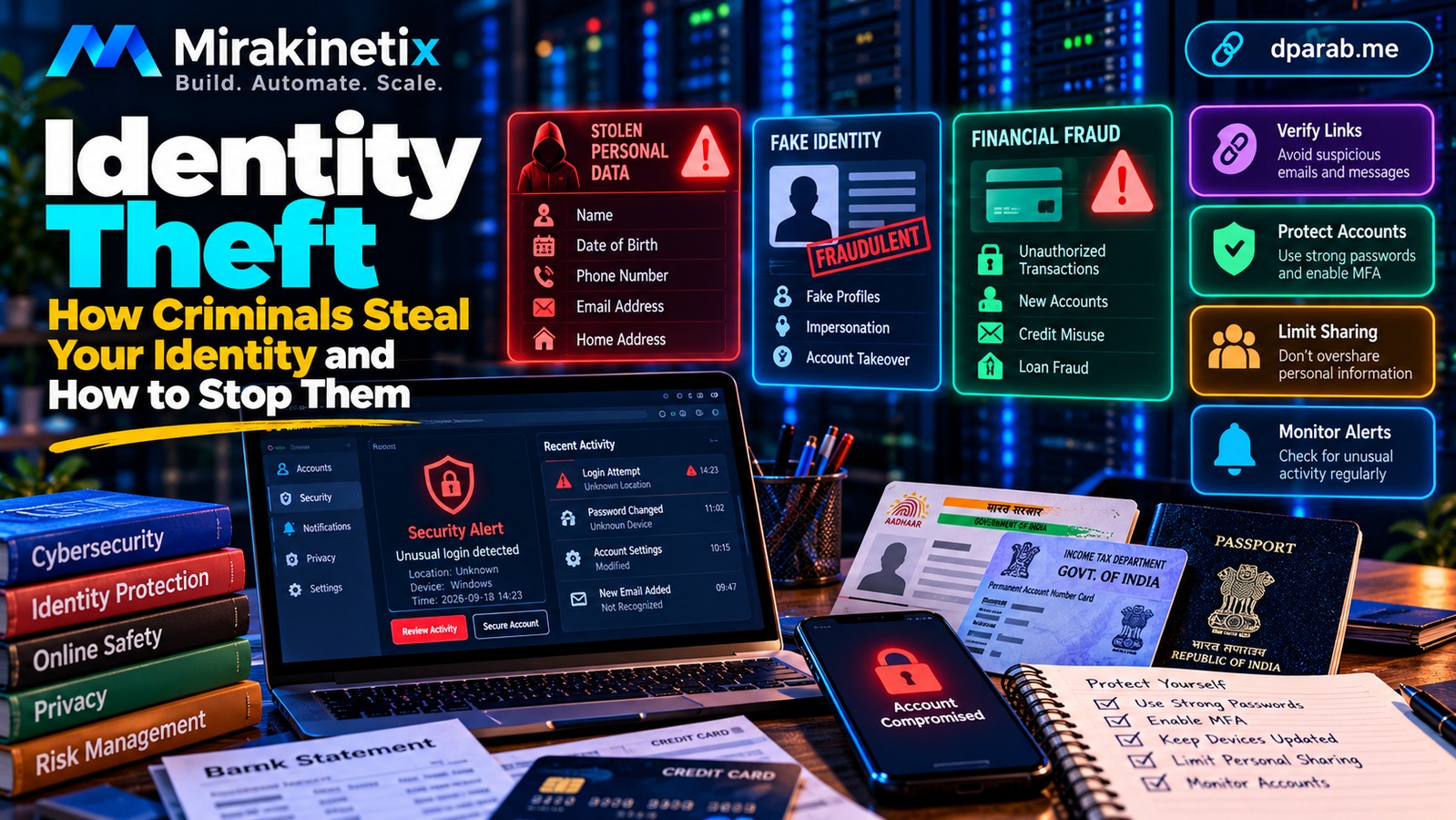
Most people associate cybercrime with sophisticated hackers breaking into corporate servers. In reality, many attacks begin with something much simpler: personal information obtained through a deceptive message, a compromised account, an exposed document, or an unsuspecting victim.
Your name, phone number, email address, date of birth, identity documents, and financial details can help criminals impersonate you. Once they have enough information, they may attempt to access your accounts, deceive your contacts, apply for services in your name, or facilitate financial fraud.
This is identity theft. Understanding how it happens is the first step toward preventing it.
What Is Identity Theft?
Identity theft occurs when someone uses your personal information without authorization, often to impersonate you or commit fraud.
It can involve:
Taking over your email or social media accounts.
Using stolen personal details to attempt financial fraud.
Creating fake profiles in your name.
Misusing copies of identity documents.
Impersonating you to deceive friends, family members, or businesses.
Using compromised credentials to access other services.
Identity theft does not always result in immediate financial loss. A criminal may first collect information, establish credibility, and wait for an opportunity to exploit it.
How Criminals Steal Your Identity
1. Phishing and Fake Websites
Attackers send emails, text messages, or social media messages that appear to come from trusted organizations. They may claim that your bank account will be blocked, a parcel is awaiting delivery, or your account requires verification.
The link leads to a fraudulent website designed to collect passwords, payment information, or other personal details.
Protect yourself: Visit official websites directly instead of following unexpected links. Never enter credentials after clicking a suspicious message.
2. Data Breaches and Reused Passwords
When an online service suffers a data breach, exposed email addresses and passwords may be used in automated attempts to access accounts on other websites.
If you reuse the same password for email, shopping, banking-related services, and social media, one compromised service can put several accounts at risk.
Protect yourself: Use a unique password for every important account. A reputable password manager can help you manage them.
3. Social Engineering
Social engineering manipulates people into disclosing information or authorizing actions. A caller might impersonate a bank employee, technical support representative, delivery agent, or government official.
The attacker may create urgency, threaten account suspension, or promise a refund to pressure the victim into cooperating.
Protect yourself: End unexpected calls requesting passwords, OTPs, PINs, or remote access to your device. Independently contact the organization using its official contact details.
4. Oversharing on Social Media
Public posts can reveal birthdays, family relationships, workplaces, travel plans, and other details that help criminals construct convincing impersonation attempts.
Information about family members can also be used to make fraudulent messages appear genuine.
Protect yourself: Review privacy settings, limit public personal information, and avoid posting identity documents or sensitive travel details.
5. Malicious Apps and Unsafe Downloads
An untrustworthy application may request excessive permissions, collect personal information, or expose your device to malware. Some fraudulent applications attempt to capture credentials or persuade users to grant remote access.
Protect yourself: Install applications from trusted sources, examine permissions, keep your operating system updated, and remove applications you no longer need.
6. Misuse of Identity Documents
Copies of passports, driving licences, Aadhaar documents, PAN cards, and other records may be exposed through insecure storage, fraudulent requests, or compromised accounts.
Possession of a document does not automatically mean a criminal can successfully impersonate you everywhere. However, exposed documents can provide information useful for targeted fraud.
Protect yourself: Share documents only when necessary, verify the recipient, use secure channels, and consider masking permitted information where the receiving organization accepts it.
Warning Signs You Should Never Ignore
Look out for these indicators:
Password-reset messages you did not request.
Login alerts from unfamiliar devices or locations.
Changes to recovery email addresses or phone numbers.
Unexpected OTPs or authentication prompts.
Financial transactions you cannot recognize.
Friends receiving suspicious messages supposedly sent by you.
Unknown accounts, applications, or services associated with your details.
Unexpected bills, account notices, or credit enquiries.
One warning sign does not always prove identity theft, but unexplained account activity deserves prompt investigation.
What to Do If Your Identity Is Stolen
Act quickly, using a device you believe is secure.
Step 1: Secure your email account. Change its password, review recovery methods, sign out unfamiliar sessions, and enable multi-factor authentication. Email often controls password recovery for other services.
Step 2: Secure affected accounts. Change compromised and reused passwords, revoke unknown sessions, remove suspicious connected applications, and review account recovery settings.
Step 3: Contact your bank or financial service provider. If payment details or banking access may be compromised, use official contact channels to report the incident, block affected instruments where appropriate, and dispute unauthorized transactions.
Step 4: Preserve evidence. Keep screenshots, suspicious messages, transaction references, email headers where available, dates, and complaint numbers. Do not delete evidence before recording it.
Step 5: Report the incident. In India, suspected cybercrime can be reported through the National Cyber Crime Reporting Portal at https://cybercrime.gov.in. If financial fraud is ongoing or money has been lost, contact the national cybercrime helpline at 1930 as quickly as possible and follow the instructions provided. Contact your bank immediately as well.
Step 6: Monitor for further misuse. Review financial accounts, credit reports where applicable, and important online services for unfamiliar activity. Follow the relevant institution's process if your identity documents may have been misused.
How to Reduce Your Risk Before an Attack
You do not need expensive security software to establish a strong foundation.
Use unique passwords and a password manager.
Enable multi-factor authentication, preferably phishing-resistant passkeys or security keys where supported.
Keep your phone, computer, browser, and applications updated.
Secure your primary email account first.
Never disclose OTPs, PINs, passwords, or recovery codes to callers or message senders.
Review account sessions, recovery methods, and connected applications periodically.
Limit unnecessary sharing of identity documents and personal details.
Enable transaction alerts and review financial activity.
Back up important data and protect backup access.
Teach family members to verify unusual requests through a separate, trusted communication channel.
For Aadhaar-related concerns, use UIDAI's official website at https://uidai.gov.in to review available authentication-history and biometric-locking facilities. Availability and suitability depend on the specific service and situation.
Final Thoughts
Identity theft is not always the result of a technical vulnerability. It can begin with a convincing phone call, a reused password, an exposed document, or a single careless click.
The most effective defense is a combination of secure accounts, limited disclosure of personal information, regular monitoring, and a calm response when something looks wrong.
Your personal information cannot always be kept completely private. But by making it harder to obtain, harder to misuse, and easier to protect, you can significantly reduce the opportunities available to criminals.
The rule to remember: Verify first, share only what is necessary, and act immediately when you detect suspicious activity.


