
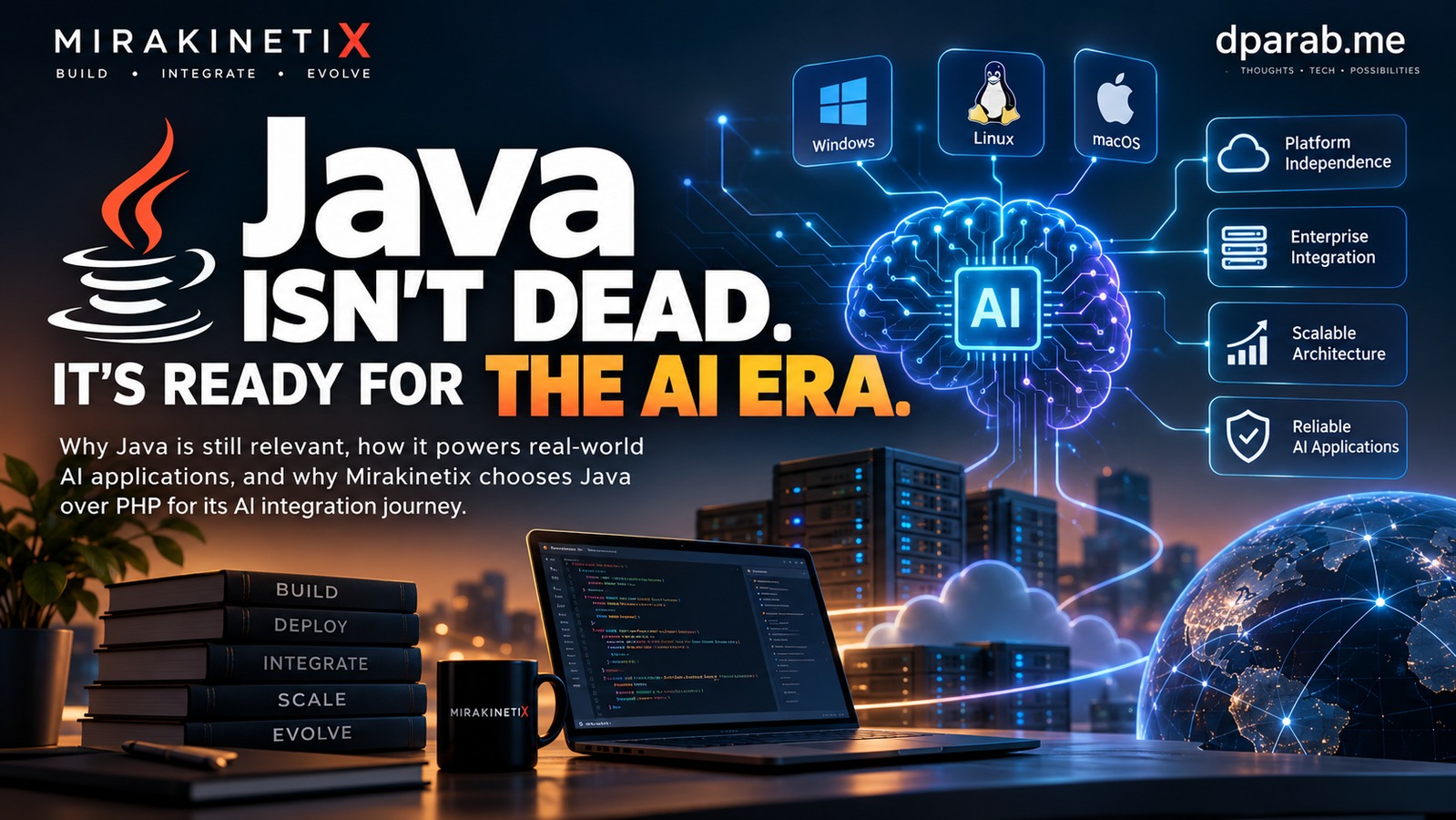
Java Isn't Dead. It's Ready for the AI Era.
Every few years, the software industry declares another programming language dead.
Java has faced that prediction for years. PHP has been written off repeatedly. Python dominates much of today's artificial intelligence conversation, while new frameworks promise to change how applications are built.
But there is a difference between building a prototype and engineering an application that people can depend on.
Real applications need security, reliable APIs, data management, error handling, testing, deployment automation, and maintainability. When artificial intelligence enters the picture, these requirements become even more important.
At Mirakinetix, we believe Java remains a strong choice for building modern applications. Our primary reason for choosing it is platform independence: the ability to develop applications that run across supported operating systems using the Java Virtual Machine (JVM), without maintaining an entirely separate implementation for every platform.
Java's mature ecosystem, development tools, and integration capabilities strengthen that decision. We are putting our approach into practice through three public Java repositories: Callsmith, MkFlowForge, and Password-Guruji.
These projects are works in progress, not claims of finished, production-ready products. They give developers an opportunity to inspect our source code, explore our approach, and follow our development journey.
Here is why Java remains relevant, how it fits into our engineering direction, and why we believe it has an important role to play in the AI era.
1. Platform Independence: The Reason We Chose Java
Java's long-standing principle, Write Once, Run Anywhere, remains relevant.
Java source code is compiled into bytecode, which runs on a compatible Java Virtual Machine. This allows the same compiled application to operate across supported environments without requiring a separate codebase for each operating system.
Consider two scenarios. A backend service might be developed on Windows and deployed to a Linux server. A desktop application might target both Windows and macOS. Java provides a common runtime foundation for these use cases, although desktop packaging and server deployment require different approaches.
For Mirakinetix, this flexibility gives us more freedom when deciding where our applications should run. We can focus on the application's functionality and architecture instead of unnecessarily coupling its core logic to one operating system.
Portability is not automatic perfection. Native libraries, environment configuration, filesystem conventions, permissions, and external dependencies can introduce platform-specific challenges. Applications must still be tested in their intended environments.
Combined with Git-based development and automated builds, Java's runtime model supports a consistent development process and makes it easier to move applications between supported environments.
Our decision is based on a practical engineering priority: build applications that can evolve without being unnecessarily tied to a particular operating system.
2. AI Applications Need More Than AI Models
Python is enormously important to AI development. Its machine-learning libraries, data-science ecosystem, and experimentation tools make it a natural choice for many research and model-development tasks.
But an AI model is only one component of a complete application.
Imagine an AI-powered business assistant. It needs to authenticate users, retrieve authorised information, communicate with a model, enforce business rules, record relevant events, and respond appropriately when a service becomes unavailable.
What happens when the model provider times out? How do we control API costs? How do we prevent unauthorised data access? What happens when a model returns an invalid or misleading answer?
These are software engineering challenges.
A dependable AI application needs a well-designed application layer around its model. Java can provide that layer through its backend ecosystem, testing tools, security libraries, and support for structured services.
Java does not need to train a model to power an AI application. It can call hosted AI services, coordinate workflows, manage data, enforce permissions, and expose capabilities through APIs.
The model provides a capability. The surrounding software determines how that capability is used.
3. Java and Enterprise AI Integration
Java has a long history in enterprise systems that connect databases, internal services, identity providers, business applications, and external APIs. Those integration requirements remain important when AI is introduced.
Frameworks such as Spring Boot provide a foundation for developing backend services. Spring AI offers abstractions and integrations for connecting Java applications with AI models, embeddings, vector stores, and related components.
These tools are building blocks, not automatic guarantees of a secure or intelligent system. Their value depends on how the architecture is designed and implemented.
A Java-based AI service could authenticate a request, retrieve relevant information, send selected context to a model, validate the response, apply business rules, and return the result through an API.
The application can also monitor failures, enforce rate limits, and record appropriate audit information.
A well-designed architecture can separate business logic from the AI provider. If the application uses clearly defined interfaces, replacing a model provider or changing part of the AI pipeline may be possible without rebuilding the entire system.
For Mirakinetix, the objective is not merely to connect software to an AI API. It is to integrate AI into applications in a way that remains manageable, secure, and maintainable as requirements evolve.
4. Why Mirakinetix Is Choosing Java Over PHP
This decision deserves a clear explanation because PHP remains a capable language for modern application development.
PHP can integrate with AI APIs, power sophisticated web applications, process background jobs, and support scalable services. Laravel provides substantial capabilities for authentication, queues, caching, database operations, and API development.
We are not choosing Java because PHP cannot work with AI. We are choosing Java because its characteristics fit the direction we want to pursue.
A mature ecosystem: Java provides established tools for API development, security, testing, integration, and operational management.
Structured application development: Java's static type system and established development conventions can help teams organise larger codebases and define clear interfaces. These benefits still depend on good engineering practices.
Long-term maintainability: A consistent technology direction can help us develop shared expertise, reusable components, automated tests, and repeatable build processes.
A strategic foundation: Choosing a primary technology for new applications gives us a clearer basis for architectural decisions and future development.
This is a deliberate technology choice, not a universal rule. Rewriting a working PHP application simply to change languages may create more risk and expense than value. Existing systems should be evaluated on their own merits.
The right language is the one that best fits the system's requirements, constraints, and future direction.
5. Java Does Not Have to Compete With Python
The Java-versus-Python debate often assumes that one language must replace the other. Real systems are not that simple.
Python can be used for model development, experimentation, specialised machine-learning pipelines, and data processing. Java can manage application workflows, APIs, permissions, and integration with other business systems.
A solution may use a Python service for a particular model while Java handles the surrounding application. Another solution may simply call a hosted AI model through an API.
Both approaches can be valid.
The important question is not which language wins a popularity contest. It is how the system should be divided into components, how those components communicate, and how they can be operated and maintained reliably.
At Mirakinetix, choosing Java for our application development direction does not mean every component must be written in Java. It means we have a clear foundation for the kinds of applications we want to build.
6. AI Makes Security and Engineering Discipline More Important
AI can generate incorrect information, retrieve irrelevant material, or respond in ways that do not satisfy an application's requirements. AI-enabled systems can also introduce risks when they have access to private information or tools that perform actions.
These problems cannot be solved by choosing a programming language alone.
A responsible application needs appropriate access controls, input and output validation, rate limits, cost monitoring, failure handling, and meaningful testing. Sensitive or irreversible actions may need human approval. Logs should support troubleshooting without unnecessarily exposing credentials or personal information.
Retrieval-augmented generation (RAG), for example, allows a system to retrieve relevant documents and supply them as context to a model. The application must ensure that users only retrieve information they are authorised to access, and retrieved content must not automatically be treated as trusted instructions.
Java can provide the application infrastructure for implementing these controls. The development team remains responsible for getting them right.
As AI makes generating code easier, engineering judgment becomes more valuable. Building a demonstration is one challenge; building a system that behaves predictably under real-world conditions is another.
7. Explore Our Public Java Projects
Technology decisions are more meaningful when readers can examine real projects rather than rely solely on claims.
Mirakinetix has three public Java repositories available for developers to explore. All three are ongoing projects, not claims of finished, production-ready products. Features, documentation, stability, and setup requirements may vary by project.
We are sharing the source code so developers can inspect our approach, follow progress, test what is currently available, and provide constructive feedback.
Callsmith — API Development and Testing
Callsmith is intended to be a free alternative to Postman for API development and testing. Its public repository uses Java 25, JavaFX, Maven, and related technologies.
The first build has been completed, but the application remains under development and needs further improvements before it should be presented as a finished product.
If you explore Callsmith, review the current README, build instructions, and documented limitations before trying it. Feedback and issue reports are welcome through the repository's available contribution channels.
MkFlowForge — Local Desktop Voice Dictation
Explore MkFlowForge on GitHub ↗
MkFlowForge is a Java desktop application for voice dictation, designed around local speech recognition through whisper.cpp and global keyboard shortcuts.
It demonstrates a different application use case: desktop software targeting Windows and macOS. It remains an evolving project, so check the repository documentation for current capabilities, supported platforms, and setup requirements before attempting to run it.
Password-Guruji
Explore Password-Guruji on GitHub ↗
Password-Guruji is the third public Java repository from Mirakinetix. Visit the project to inspect its source code and documentation and follow its development.
Its current functionality and readiness should be assessed using the information available in the repository rather than assumed from its public availability.
Together, these repositories make our work more visible to the developer community. They give interested readers a direct way to explore our projects instead of relying on descriptions alone.
Public source code means the code can be inspected; it does not guarantee that every feature is complete, every build will work in every environment, or any application is ready for production use. Please evaluate each project according to its documentation, current development status, limitations, and security considerations.
8. Portability Works Best With Disciplined Delivery
A consistent development workflow is just as important as the language itself.
A disciplined process starts with source code in Git, runs automated compilation and tests, checks dependencies, and produces versioned build artifacts. Those artifacts can then be tested and distributed through an appropriate release process.
For applications targeting multiple operating systems, automated builds and tests can help identify platform-specific problems earlier. Packaging still needs to account for the target operating system, runtime dependencies, permissions, and distribution requirements.
This approach is not unique to Java, but it fits naturally into a Java development workflow.
Our focus is on building from committed source, making the process repeatable, and improving applications incrementally. This creates a clearer path from a development build to a more dependable release.
9. Java Is Not the Answer to Every Problem
Java has trade-offs. Applications need appropriate runtime configuration, dependency management, testing, and operational support. A small script or a project centred on specialised machine-learning research may be better served by another language.
PHP remains useful for web applications, particularly where an existing PHP ecosystem already delivers value. Python remains essential for many AI and data-science workflows. JavaScript and TypeScript are strong options for modern web interfaces and related services.
Performance should also be evaluated through measurement rather than assumptions about a language. Database queries, network calls, model response times, memory use, and architecture may matter more than the choice of language alone.
Our decision at Mirakinetix is not that every developer should adopt Java. It is that Java aligns with our priorities for the applications we are building.
That is a strategic decision grounded in our needs, not a declaration that other technologies are obsolete.
10. Explore the Projects. Test the Ideas. Help Us Improve.
AI is changing software development, but building dependable applications still requires sound architecture, disciplined engineering, and thoughtful technology choices.
At Mirakinetix, we are putting our approach into practice through public repositories that developers can explore.
Don't just take our word for it. Explore the code, examine the implementation, and form your own opinion.
Interested in API development and testing? Start with Callsmith on GitHub ↗.
Interested in desktop automation and voice dictation? Explore MkFlowForge on GitHub ↗.
Want to explore another Java project? Visit Password-Guruji on GitHub ↗.
If you are a Java developer, software architect, AI enthusiast, or simply curious about what we are building, take a look at the repositories.
Before building or running an application, review its README, current project status, setup instructions, and known limitations. Report reproducible bugs or suggest improvements through the issue tracker, where available. Check each project's licence and contribution guidelines before reusing code or submitting contributions. Do not use development builds for critical or sensitive workloads unless you have independently assessed their suitability.
Have a different perspective on Java, platform independence, or the role of Java in AI-powered applications? Share your experience in the comments. We welcome thoughtful technical discussion, practical suggestions, and constructive criticism.
Our projects are works in progress. Feedback from developers who examine the code and test the applications can help us improve them.
At Mirakinetix, we believe technology choices should be demonstrated through engineering, not defended through hype.
Explore the code. Challenge the ideas. Help us build better software.
AI creates possibilities. Good architecture makes them practical. Engineering makes them dependable.
Java is ready to play its part in the AI era.


