
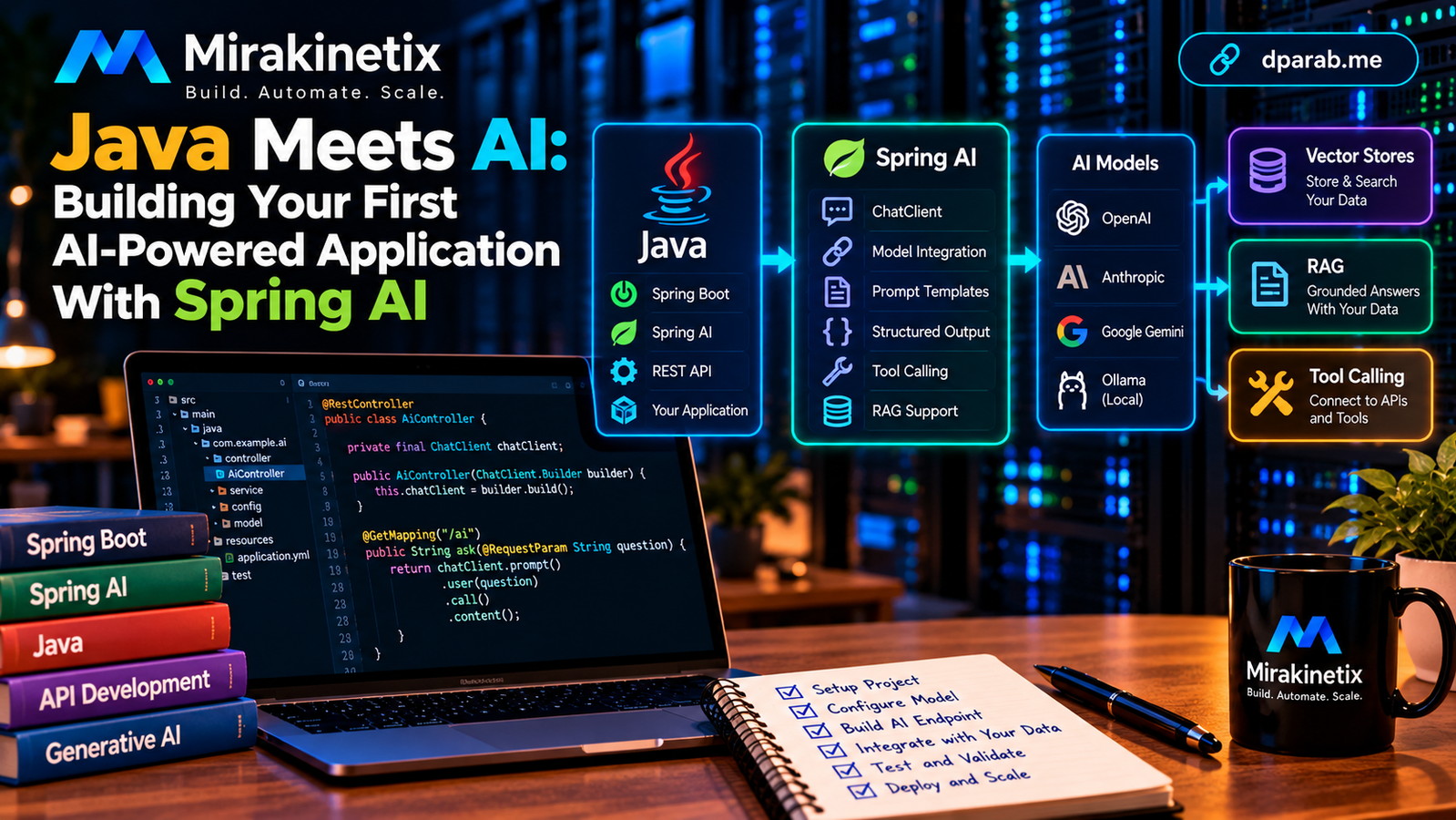
Java Developers Can Build More Than Traditional Applications
Java has long been used to build enterprise applications, backend services, APIs, and large-scale information systems. Generative AI introduces another opportunity: adding language-model capabilities to applications written in a language many development teams already understand.
Imagine an application that summarizes support tickets, answers questions about internal documentation, extracts structured information from customer requests, or helps employees search large collections of business records.
These features do not require every developer to become a machine-learning researcher. They require a sound understanding of application architecture, model integration, data handling, and reliability.
Spring AI provides a framework for connecting Java applications to AI models using familiar Spring development patterns. It helps developers focus on application behavior rather than writing provider-specific integration code from scratch.
What Is Spring AI?
Spring AI is an application framework that simplifies integrating AI capabilities into Java applications built on the Spring ecosystem. It provides abstractions for chat models, embeddings, vector stores, structured output, tool calling, and retrieval-augmented generation (RAG).
Its ChatClient API offers a fluent way to construct prompts and communicate with supported chat models. The framework also provides integrations for multiple model providers, although the capabilities and configuration options available can vary by provider.
Official resources:
The important idea is not that a framework makes AI automatically reliable. It reduces integration effort while leaving developers responsible for application design, data security, validation, and operational behavior.
Build a Simple AI-Powered Java Application
Consider a small Spring Boot service that accepts a question and returns a response generated by an AI model.
The following example illustrates the core application code. It assumes that Spring AI's appropriate model-provider starter and credentials have already been configured for your chosen provider.
import org.springframework.ai.chat.client.ChatClient;
import org.springframework.web.bind.annotation.GetMapping;
import org.springframework.web.bind.annotation.RequestParam;
import org.springframework.web.bind.annotation.RestController;

@RestController
public class AiController {

    private final ChatClient chatClient;

    public AiController(ChatClient.Builder builder) {
        this.chatClient = builder.build();
    }

    @GetMapping("/ai")
    public String ask(@RequestParam String question) {
        return chatClient.prompt()
                .user(question)
                .call()
                .content();
    }
}
This example demonstrates three basic steps:
Create a ChatClient. Spring AI provides a builder that can be configured through Spring Boot's model integration.
Submit a prompt. The user's question becomes the input to the model.
Return the response. The application extracts the generated text and returns it to the caller.
A real application also needs a configured model connection, suitable dependencies, and externalized credentials. The exact setup depends on the Spring Boot and Spring AI versions and the selected model provider.
This is a starting point for learning, not a production-ready endpoint.
Why the ChatClient Matters
Without a framework abstraction, an application may need to manage provider-specific HTTP requests, authentication headers, request formats, response parsing, and error handling itself.
Spring AI's ChatClient provides a common programming interface for many of these interactions. That can make application code easier to maintain and help teams experiment with supported providers without redesigning every business component.
However, a common interface does not make every model interchangeable. Providers differ in supported features, context limits, pricing, latency, output behavior, and configuration.
A practical architecture should keep model integration behind a well-defined service boundary. That gives the application a place to manage configuration, timeouts, retries, validation, logging, and provider-specific behavior.
Where Java and AI Become Useful Together
The most useful AI features often extend existing software rather than replace it.
Customer support: Summarize a long conversation and suggest a draft response for an agent to review.
Internal knowledge search: Let employees ask questions about approved company documents. Retrieval-augmented generation can provide relevant document passages as context for the model.
Business data extraction: Convert unstructured text into a structured representation that the application validates before saving.
Developer productivity: Explain logs, summarize incident reports, or help developers investigate an error using carefully selected diagnostic information.
These are different engineering problems, even when they use the same model API. Each requires its own approach to data access, validation, user experience, and testing.
For example, a support-ticket summarizer can tolerate some variation in wording. A system extracting invoice totals must validate amounts, currencies, and required fields before accepting the result.
Connecting AI to Your Own Data
A model's general training does not mean it knows your current business records or private documentation.
Retrieval-augmented generation, commonly called RAG, addresses this limitation by retrieving relevant information from an external source and supplying it as context for a model response.
A typical workflow looks like this:
Ingest approved documents.
Split documents into useful sections.
Generate embeddings and store them in a compatible vector store.
Retrieve relevant sections when a question arrives.
Provide the question and retrieved context to the model.
Return a response with suitable references to the source material.
Spring AI provides building blocks for this pattern, including embedding and vector-store integrations.
RAG is not a guarantee of factual accuracy. Retrieval can return incomplete or irrelevant material, and the model can still misinterpret its context. Applications should evaluate retrieval quality, distinguish sourced facts from generated explanations, and communicate uncertainty where appropriate.
Security and Reliability Are Part of the Design
An AI integration is still a software system, and it must be engineered accordingly.
Before exposing an AI-powered endpoint, consider the following safeguards:
Protect credentials: Store provider keys outside source code and version control.
Control access: Authenticate users and authorize which records they may retrieve.
Validate inputs: Apply input-size limits and reject malformed or abusive requests.
Treat model output as untrusted: Validate generated data before using it in business logic, database writes, or downstream APIs.
Manage costs: Set usage limits, monitor token consumption, and prevent uncontrolled request loops.
Handle failures: Account for timeouts, rate limits, unavailable providers, and malformed responses.
Protect privacy: Avoid sending sensitive data to external services unless the data handling arrangements and applicable policies permit it.
Test behavior: Evaluate representative prompts, edge cases, incorrect answers, and unexpected model output.
Tool calling deserves particular care. When a model can request that an application execute a function, the application must enforce permissions and validate arguments. A model's request should never be treated as authorization to perform a sensitive action.
For operations involving payments, account changes, deletion, or other consequential actions, retain explicit business rules and appropriate human approval.
Does This Mean Every Java Application Needs AI?
No. AI is useful when it solves a real problem better than a simpler alternative.
A deterministic calculation should generally remain a normal calculation. A straightforward database lookup does not need a language model. Introducing AI where it adds no meaningful value increases complexity, cost, latency, and the number of failure modes.
The right question is not whether an application can use AI. It is whether AI provides a measurable improvement while meeting the application's reliability, privacy, and cost requirements.
Java is a strong option for teams that want to add AI capabilities to existing Spring applications while retaining familiar architectural practices. Spring AI makes many integrations more accessible, but sound engineering remains essential.
Start Small, Measure, and Improve
A sensible first project is a narrow feature with a clear success criterion: summarize a support ticket, classify an incoming request, or answer questions from a small collection of approved documents.
Build a working prototype, measure its accuracy and latency, estimate its operating cost, and test failure scenarios before expanding its responsibilities.
The broader lesson is simple: building an AI-powered application is not just about connecting to a model. It is about integrating that model into software that people can use safely and reliably.
At Mirakinetix, our focus is on practical software engineering, platform independence, and building applications that can evolve with changing technology. Java and Spring AI offer one route to exploring that direction.
Explore the technology, experiment with a focused use case, and build something that solves a real problem.


