
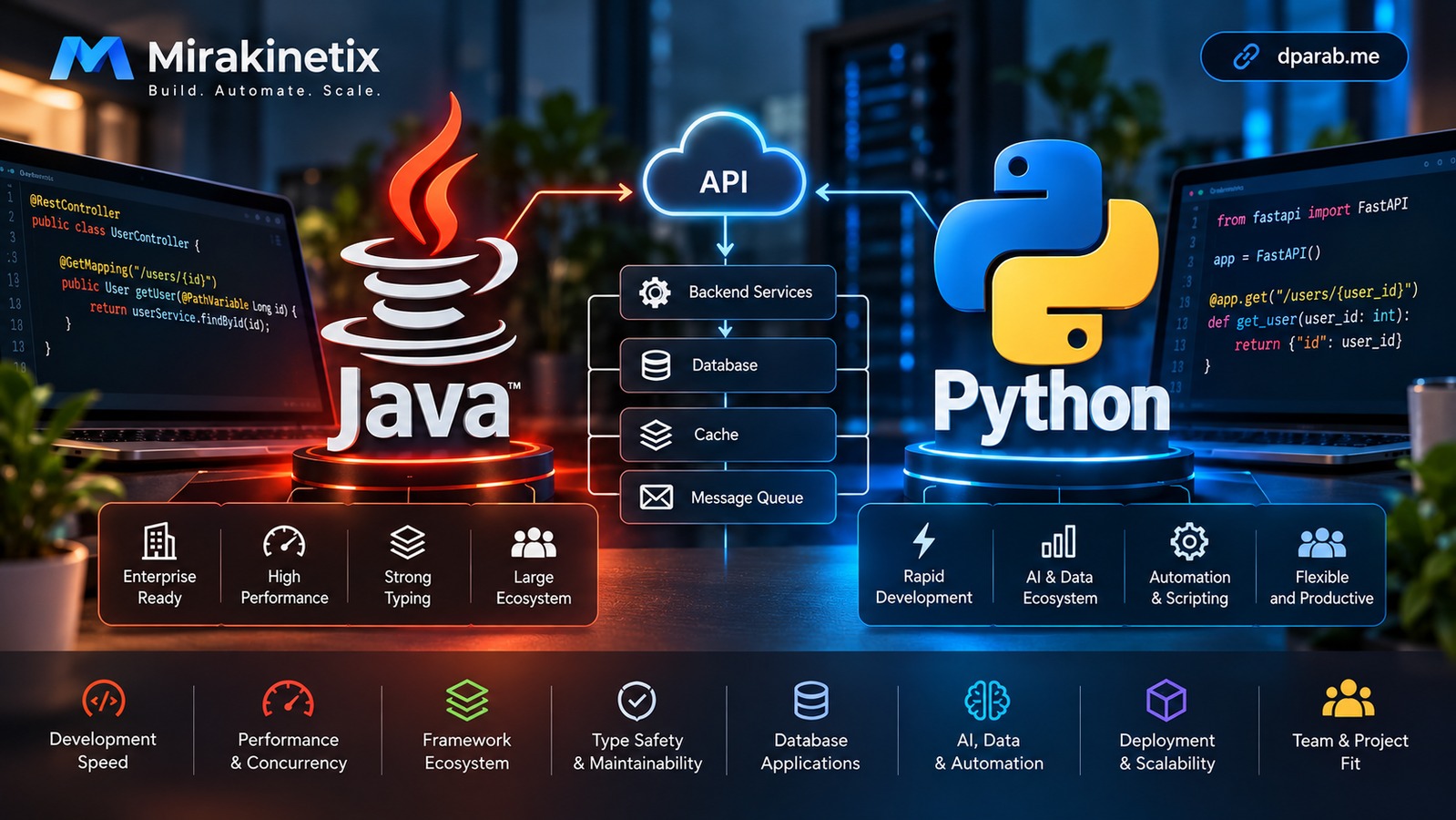
Choosing a backend technology is not simply a question of which programming language is more popular.
This guide is for backend developers, senior engineers, technical leads, architects, and engineering teams deciding whether Java or Python is a better fit for a new backend service, API, SaaS platform, enterprise application, automation system, or existing system modernization.
The comparison assumes a production environment, where factors such as maintainability, performance, scalability, team skills, deployment, monitoring, and long-term ownership matter—not just how quickly the first feature can be built.
Java and Python are both capable of powering production APIs, SaaS platforms, enterprise applications, automation systems, data services, and large-scale backend infrastructure.
The important question is:
Which technology fits the problem, the team, the architecture, and the operational requirements?
Java often shines in large, long-running enterprise systems where strong typing, mature tooling, concurrency, and predictable performance are important.
Python is particularly strong when development speed, automation, data processing, AI, and rapid iteration are major priorities.
Let's compare them from a practical backend engineering perspective.
1. Development Speed
Python generally allows developers to write functionality with less code.
For example, a simple FastAPI endpoint can be concise:
@app.get("/users/{user_id}")
def get_user(user_id: int):
    return {"id": user_id}
Java with Spring Boot typically involves more structure:
@GetMapping("/users/{userId}")
public User getUser(@PathVariable Long userId) {
    return userService.findById(userId);
}
The additional structure in Java is not necessarily a disadvantage. In large applications, explicit types, interfaces, conventions, and dependency management can make complex systems easier to understand and maintain.
Trade-off: Python can reduce the time needed to build and change features, while Java's additional structure can provide stronger guardrails as a codebase and team grow.
2. Performance and Concurrency
Java applications run on the JVM and benefit from mature Just-In-Time compilation and runtime optimization. For CPU-intensive and high-throughput workloads, Java can provide strong and predictable performance.
Python's standard implementation, CPython, has limitations for CPU-bound multithreaded workloads because of the Global Interpreter Lock. However, Python applications can still support production workloads through multiple processes, asynchronous programming, background workers, queues, and horizontal scaling.
The actual workload matters more than language benchmarks. A database-heavy application, for example, may spend most of its time waiting for database operations rather than executing application code.
Trade-off: Java can provide an advantage for CPU-heavy and highly concurrent workloads, while Python can be perfectly suitable when the workload is primarily I/O-bound or can be distributed across processes and workers.
3. Framework Ecosystem
Java has a mature enterprise ecosystem centered heavily around Spring and Spring Boot.
Spring Boot provides capabilities for:
REST APIs
Dependency injection
Security
Database access
Messaging
Configuration
Observability
Testing
Python has several strong backend frameworks.
Django
Django provides a batteries-included approach with:
ORM
Authentication
Administration
Routing
Templates
Security features
FastAPI
FastAPI is particularly useful for modern APIs where:
API development speed matters
Type hints are useful
Automatic API documentation is valuable
Async workloads are important
Trade-off: Java's ecosystem provides extensive enterprise structure and integration. Python provides several flexible approaches that can make API, automation, and data-oriented development faster.
The framework should be selected based on the application's requirements rather than language popularity.
4. Type Safety and Maintainability
Java is statically typed.
Consider:
public BigDecimal calculateTotal(BigDecimal price, int quantity) {
    return price.multiply(BigDecimal.valueOf(quantity));
}
The compiler can detect many classes of errors before the application runs.
Python supports type hints:
def calculate_total(price: Decimal, quantity: int) -> Decimal:
    return price * quantity
However, Python remains dynamically typed at runtime.
Trade-off: Java's type system can catch many errors earlier and provide strong contracts across large codebases. Python's dynamic nature can make experimentation and rapid changes easier, but teams need disciplined testing, typing conventions, and code review as systems become larger.
For a small service, Python's flexibility may be productive. For a very large codebase with many teams, Java's explicit contracts may provide useful consistency.
5. Database Applications
Both Java and Python have mature database ecosystems.
A typical Java architecture might look like:
Controller
    ↓
Service
    ↓
Repository
    ↓
Database
Spring Data can simplify repository implementation.
Python applications can use Django ORM, SQLAlchemy, or framework-specific database integrations.
Regardless of language, the same database principles apply:
Proper indexing
Query optimization
Connection pooling
Transactions
Pagination
Avoiding N+1 queries
Monitoring slow queries
A badly designed SQL query will remain badly designed whether it comes from Java or Python.
Trade-off: There is usually no fundamental reason to choose one language solely because of the database. Query design, schema design, indexing, connection management, and transaction handling will generally have a greater effect on database performance.
6. AI, Data and Automation
This is an area where Python has a major ecosystem advantage.
Python is widely used for:
Machine learning
Data science
AI applications
Automation
Scientific computing
Data pipelines
Model experimentation
Java can also integrate with AI services and machine-learning systems, particularly when AI functionality needs to become part of a larger enterprise application.
A common architecture can therefore be:
Java Enterprise Application
          ↓
       REST API
          ↓
Python AI Service
          ↓
      ML Model
Trade-off: Python is often more convenient when AI, data science, experimentation, or automation is central to the project. Java may be preferable for the surrounding transactional or enterprise platform.
The languages do not have to compete. They can coexist.
7. Deployment and Scalability
Both technologies can be containerized and deployed using modern infrastructure.
A typical production architecture might look like:
                 Load Balancer
                /      |      \
          App #1    App #2    App #3
               \       |       /
                \      |      /
                  Database
                     |
                  Redis
                     |
                   Queue
The architecture should be designed around the workload rather than assuming that the language itself determines scalability.
Important questions include:
Is the application stateless?
Is the database optimized?
Is caching being used correctly?
Are expensive operations asynchronous?
Can application instances be added safely?
Are external services protected with timeouts?
Are queues and workers monitored?
Is there sufficient observability?
Trade-off: Both Java and Python can participate in horizontally scaled architectures. The difference is more apparent when workload characteristics require specific runtime behavior. Scaling the application does not remove database bottlenecks, poor queries, inefficient algorithms, or weak observability.
Production operations are also similar across both ecosystems:
Environment configuration
Secrets management
HTTPS
Database migrations
Logging
Health checks
Metrics
Alerting
Backups
Rollbacks
8. When Java Makes Sense
Java is often a strong fit when you are building:
Large enterprise applications
Financial systems
High-throughput backend services
Long-running services
Complex business platforms
Systems with large engineering teams
Applications requiring strong static typing
Systems already invested heavily in the JVM ecosystem
Java Trade-offs
The benefits come with practical considerations:
More application structure can mean more code and configuration.
Development can feel slower for small prototypes.
JVM applications can require more runtime resources than very small Python services.
The ecosystem can introduce significant architectural complexity if the project does not need it.
Java becomes particularly useful when the benefits of structure, performance, and enterprise tooling justify that additional complexity.
9. When Python Makes Sense
Python can be particularly effective for:
Rapidly developed APIs
Automation platforms
AI-enabled applications
Data processing services
Internal tools
Prototypes that may become production systems
Integration services
Backend services where development speed is important
Python Trade-offs
Python also has practical considerations:
CPU-bound workloads may require multiprocessing, native extensions, or other architectural approaches.
Dynamic typing requires stronger testing and development discipline as systems grow.
Large applications can become difficult to maintain without clear architecture and conventions.
High-scale workloads may require additional process, worker, or service-level architecture.
Python's productivity advantage is strongest when the team uses good engineering practices rather than relying on the language's flexibility alone.
10. A Practical Decision Framework
Instead of choosing based on language popularity, evaluate these factors:
RequirementJavaPythonEnterprise applicationsStrong fitStrong fitRapid developmentGoodStrongStatic typingStrongOptionalAI/ML ecosystemGoodStrongData scienceGoodStrongHigh-throughput servicesStrongDepends on architectureAutomationGoodStrongLarge existing JVM ecosystemStrongLess relevantRapid API developmentGoodStrongLong-lived complex systemsStrongStrong
These are general engineering characteristics, not absolute rules. Framework choice, architecture, database design, team expertise, and operational requirements can change the outcome.
11. Project Type Decision Guide
A useful way to make the decision is to start with the type of project rather than the language.
Project TypePractical Starting PointMain Trade-offEnterprise business platformJavaMore structure in exchange for strong typing and mature enterprise toolingBanking or financial transaction systemJavaMore development structure in exchange for mature transactional and enterprise capabilitiesHigh-throughput APIJavaGreater runtime structure in exchange for strong performance characteristicsAI-powered applicationPythonDynamic runtime in exchange for a strong AI/ML ecosystemData processing pipelinePythonRuntime constraints for CPU-heavy work in exchange for extensive data toolingAutomation platformPythonLess static enforcement in exchange for faster developmentRapid MVP or prototypePythonMore architectural discipline may be needed if the prototype becomes a large systemREST API for a business applicationJava or PythonThe decision depends heavily on team skills, workload, and existing infrastructureLarge existing JVM platformJavaStaying within the ecosystem may reduce integration and operational complexityAI service alongside an enterprise platformJava + PythonAdditional service boundaries and operational complexity in exchange for using each ecosystem where it fitsInternal developer or operations toolPythonLess enterprise structure in exchange for rapid implementationLong-lived, complex backendJava or PythonBoth can work; architecture and engineering discipline become increasingly important
A Simple Rule of Thumb
Use Java when the project is primarily a large, structured, transaction-heavy business system.
Use Python when the project is primarily about rapid development, automation, data, AI, or experimentation.
Consider both when the system contains clearly different workloads that benefit from different ecosystems.
This is a starting point, not a rigid rule. Existing team expertise, infrastructure, security requirements, hiring constraints, and long-term maintenance plans can change the decision.
12. You Don't Always Have to Choose One
Modern systems frequently use multiple languages.
For example:
                    API Gateway
                         |
             +-----------+-----------+
             |                       |
       Java Services           Python Services
             |                       |
       Business Logic          AI / Data Processing
             |                       |
             +-----------+-----------+
                         |
                      Database
Java can handle core transactional services while Python handles AI, automation, or data-processing workloads.
The services communicate through APIs, queues, or event streams.
Trade-off: A polyglot architecture can let each service use an appropriate technology, but it also increases operational complexity. Teams may need to maintain multiple build systems, deployment processes, runtime environments, monitoring approaches, and skill sets.
Use multiple languages because the architectural benefit is clear—not simply because both languages are available.
13. The Most Important Decision
The biggest mistake is selecting a technology because it is fashionable.
Instead, start with the system requirements.
Ask:
What problem are we solving?
What workload will the application handle?
How much traffic is expected?
What are the latency requirements?
Does the system need AI or data-processing capabilities?
What skills does the engineering team already have?
Which ecosystem integrates best with existing infrastructure?
How will the system be monitored and deployed?
What will the application look like five years from now?
The answers should drive the technology choice.
Final Thoughts: What Should You Choose?If you are building a backend today, don't start by asking "Is Java better than Python?"
Start by asking "What does my application need?"
Choose Java when the project benefits from strong static typing, mature enterprise tooling, JVM capabilities, and a long-lived, highly structured backend environment.
Choose Python when rapid development, automation, APIs, AI, data processing, or close integration with the Python ecosystem are important.
And if your system genuinely has different requirements in different areas, using Java and Python together is a valid architectural approach.
Your final decision should consider four things:
Workload + Team + Ecosystem + Operations
A language is only one part of the system. Good architecture, database design, security, observability, deployment, and engineering practices will often have a greater impact on the application's long-term success.
Choose the technology that solves your actual problem today while giving your team a maintainable path for tomorrow.


