
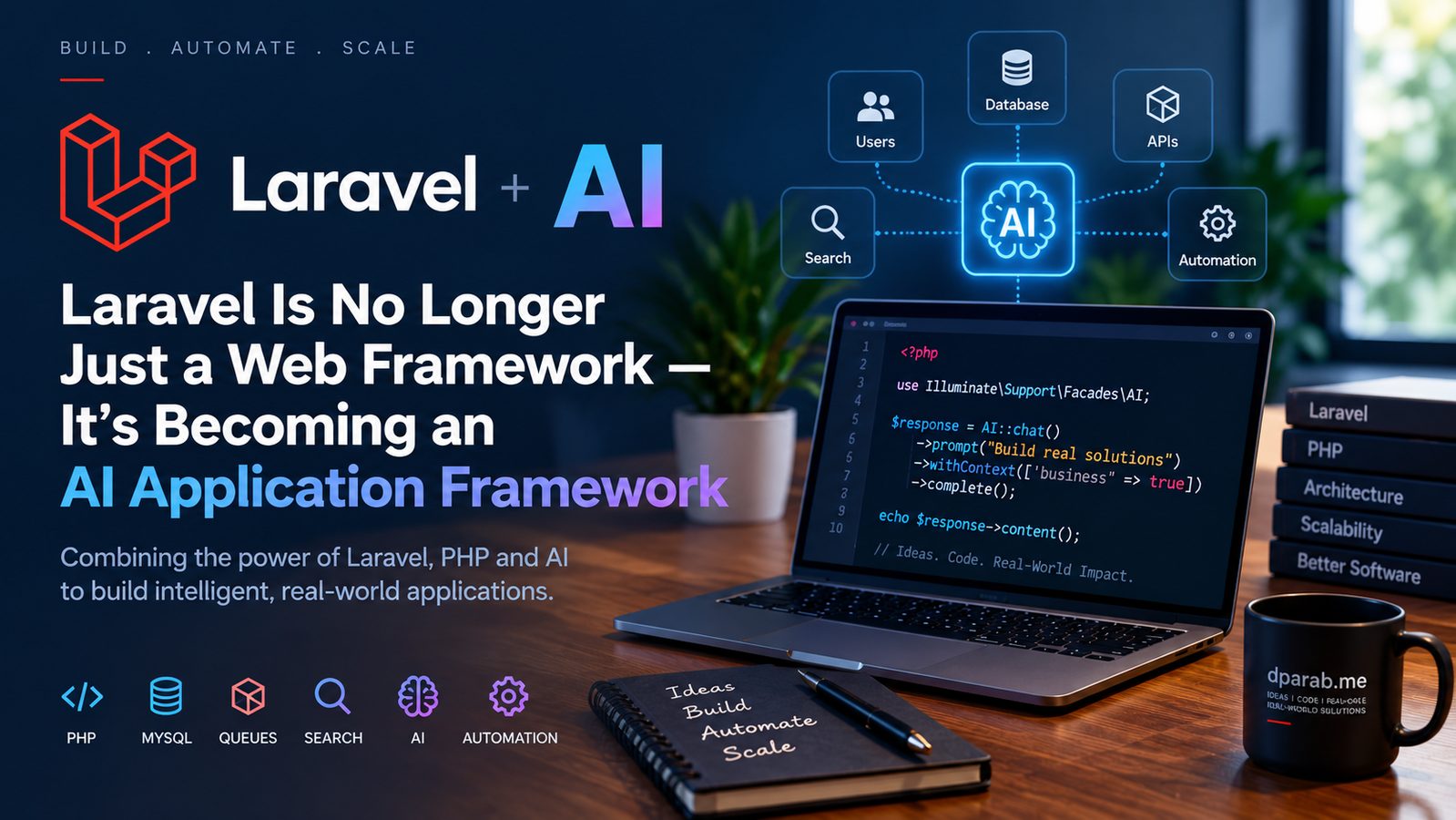
Artificial intelligence is rapidly becoming part of everyday software development.
From AI-powered search and content generation to intelligent automation, recommendations, chatbots, document processing, and data analysis, modern applications are expected to do much more than simply store and display information.
But this raises an important question for PHP developers:
Do we need to replace our existing Laravel applications to take advantage of AI?
The short answer is no.
Laravel can provide a strong foundation for building AI-enabled applications. Instead of replacing your existing architecture, AI can become another service within it.
AI Does Not Replace Your Application Architecture
One of the biggest misconceptions about AI development is that an application needs to be completely rebuilt around an AI model.
In many real-world applications, the AI component is simply another service.
A typical architecture can look like this:
Laravel Application
        |
        +---- MySQL
        |
        +---- Redis
        |
        +---- Queue Workers
        |
        +---- AI API
        |
        +---- External Services
Laravel can continue handling authentication, authorization, business logic, database operations, APIs, billing, user management, logging, and application workflows.
The AI service handles the tasks where machine intelligence adds value.
This separation makes the application easier to maintain, test, and scale.
Where Laravel Fits Into an AI Application
Laravel is particularly useful as the orchestration layer between users, business logic, databases, and AI services.
Consider an application where a user uploads a document and wants to ask questions about it.
The workflow could be:
The user uploads the document.
Laravel validates the request.
The document is stored securely.
A queue job processes the document.
The required information is extracted and prepared.
An AI service processes the relevant information.
The result is stored in the database.
The user receives the response through the Laravel application.
The AI model is only one component of the complete system.
Laravel Queues Become Extremely Important
AI operations can take longer than normal database queries or API requests.
Blocking a web request while waiting for an AI service can create a poor user experience and consume valuable application resources.
This is where Laravel queues become extremely useful.
Instead of processing an expensive operation during the user's request, Laravel can dispatch a background job.
ProcessDocument::dispatch($document);A queue worker can then process the job independently.
Queues are particularly useful for:
Document processing
AI-generated reports
Content generation
Data classification
Embedding generation
Large-scale summarization
Batch AI processing
Redis can also be used as a queue backend and caching layer when an application requires higher throughput.
AI APIs Can Be Integrated Like Other Services
From an architectural perspective, an AI API is still an external service.
Laravel's HTTP client can communicate with external APIs without tightly coupling the AI provider to the rest of the application.
use Illuminate\Support\Facades\Http;

$response = Http::post($endpoint, [
    'model' => $model,
    'input' => $prompt,
]);

$result = $response->json();
The exact API format depends on the AI provider, but the architectural principle remains the same.
Your application should treat the AI provider as a dependency rather than allowing AI-specific logic to spread throughout the entire codebase.
Create a Dedicated AI Service Layer
For larger applications, a dedicated AI service layer can make the architecture cleaner.
app/
├── Services/
│   └── AI/
│       ├── AIService.php
│       └── Providers/
│           ├── OpenAIProvider.php
│           └── OtherProvider.php
Controllers can communicate with the application's AI service instead of directly calling a specific provider.
$answer = $aiService->generate($prompt);This provides an important architectural advantage.
If the application later changes AI providers, models, pricing strategies, or processing workflows, the rest of the application does not necessarily need to change.
MySQL Still Matters in AI Applications
AI does not eliminate the need for a properly designed database.
In many cases, AI applications generate and consume large amounts of structured data.
Your database may need to store:
User interactions
Prompts and responses
AI usage statistics
Usage and consumption information
Documents
Processing status
Application metadata
Audit records
A poorly designed database can become a bottleneck regardless of how powerful the AI model is.
Indexes, query optimization, connection management, caching, and proper schema design remain fundamental engineering concerns.
Redis Can Reduce Unnecessary AI Calls
AI API calls can consume both time and money.
Not every request needs to result in a new model invocation.
For appropriate use cases, Laravel applications can use Redis to cache results.
$result = Cache::remember(
    'ai-response-' . $key,
    3600,
    function () use ($prompt) {
        return $this->aiService->generate($prompt);
    }
);
Caching needs to be designed carefully because AI responses can depend on changing context. However, where repeated requests are predictable, caching can reduce unnecessary processing.
AI Should Be Part of the Business Workflow
The real value of AI is not simply adding a chatbot to an application.
The more interesting opportunities appear when AI becomes part of an application's existing business workflows.
Consider a customer support platform.
Instead of simply adding a chatbot, AI could:
Classify incoming tickets.
Identify priority levels.
Summarize customer conversations.
Suggest responses.
Extract important information.
Route tickets to appropriate teams.
Identify frequently occurring problems.
Laravel can coordinate these workflows while AI provides the intelligence required for specific tasks.
Security Cannot Be an Afterthought
Adding AI to an application introduces additional security considerations.
Depending on the architecture and provider, applications may send sensitive information to external AI services.
Developers should carefully consider:
What data is being sent to the AI service.
Whether sensitive information needs to be removed or anonymized.
How API credentials are stored.
How AI-generated content is validated.
How users are authorized to access AI features.
How prompts and responses are logged.
How abuse and excessive usage are controlled.
AI output should also be treated as untrusted input when it reaches application logic, databases, or other systems.
Don't Put AI Logic Directly Into Controllers
A common mistake is putting the entire AI workflow inside a controller.
public function generate(Request $request)
{
    // Validate request

    // Build prompt

    // Call AI API

    // Process response

    // Save result

    // Return response
}
This may work for a prototype, but it can become difficult to maintain as the application grows.
A better architecture separates responsibilities:
Controller
    |
    +---- Service
            |
            +---- AI Provider
            |
            +---- Queue
            |
            +---- Repository / Model
This keeps the application's business logic independent from the AI implementation.
Build AI Features Incrementally
Applications do not necessarily need to become fully AI-driven overnight.
A practical approach is to identify one workflow where AI can provide measurable value.
For example:
Identify a repetitive workflow.
Measure the existing process.
Introduce AI into one part of the workflow.
Track accuracy, cost, latency, and user experience.
Improve the implementation.
Expand to additional workflows when appropriate.
This approach also makes it easier to understand the actual operational cost of AI before deploying it throughout the application.
The Future of PHP and Laravel Is Not Separate From AI
AI development is sometimes presented as something completely separate from traditional software engineering.
In production systems, that distinction is becoming less meaningful.
A successful AI-powered product still needs authentication, authorization, databases, APIs, background workers, caching, monitoring, logging, security, billing, and reliable infrastructure.
These are software engineering problems that existed before generative AI and will continue to exist alongside it.
Laravel provides many of the building blocks required to solve them.
Final Thoughts
AI does not mean abandoning Laravel, PHP, MySQL, Redis, queues, or established application architecture.
Instead, developers can use AI as another capability inside a well-designed software system.
The important shift is architectural.
Don't build an application around AI simply because AI is available. Build a solid application and introduce AI where it creates genuine value.
For Laravel developers, this creates an interesting opportunity. Building AI-enabled applications does not necessarily require abandoning an existing technology stack. It requires understanding how intelligent services can be integrated into reliable, secure, and scalable software.
AI may be changing software development, but good software engineering still matters.


