
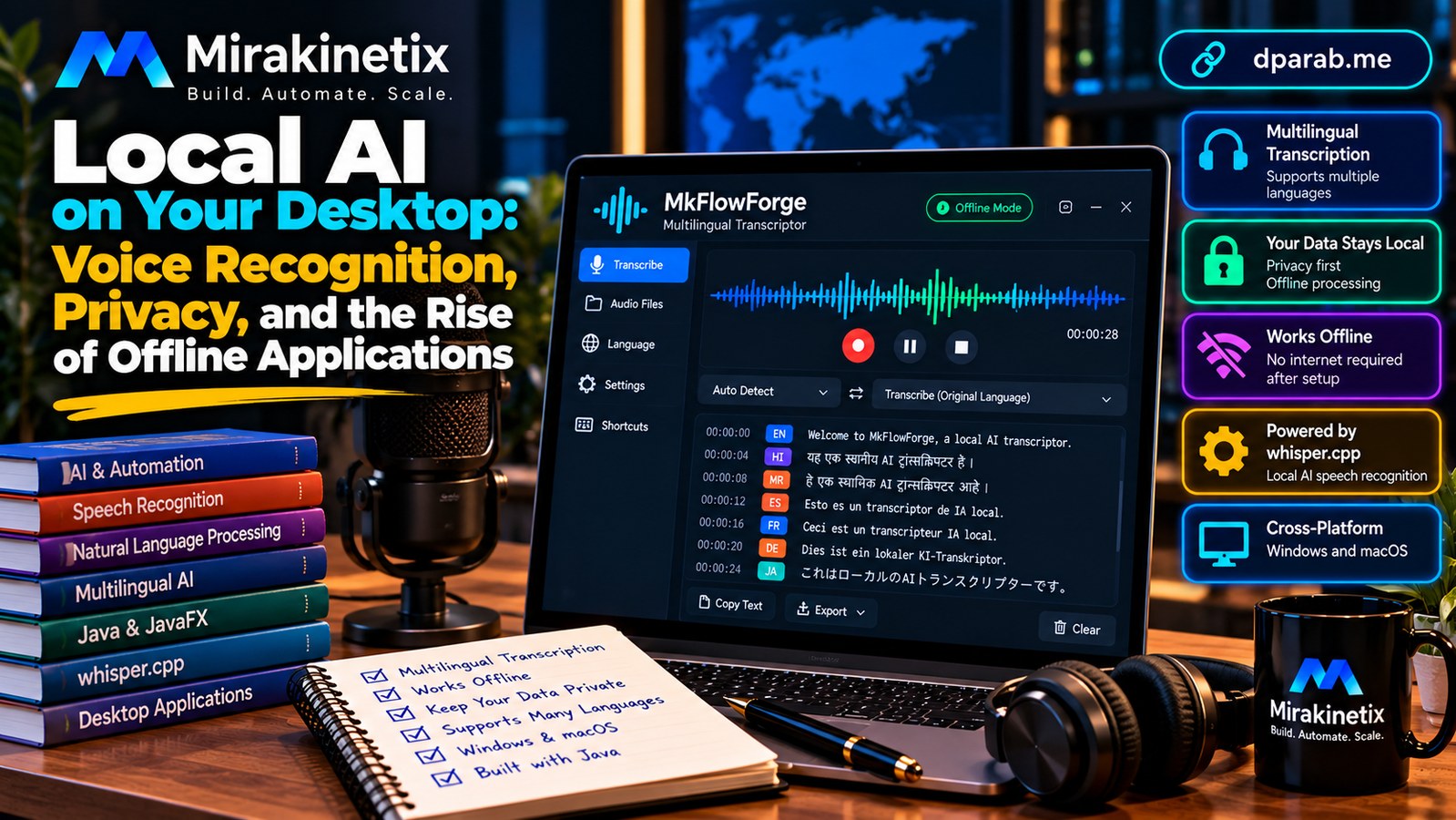
What If Your AI Could Transcribe Multiple Languages Without the Cloud?
Many AI applications depend on remote servers. You send a request over the internet, a service processes it, and the response returns to your device.
This approach provides access to powerful computing resources, but it also introduces dependencies on internet connectivity, service availability, pricing, and the provider's data-handling policies.
Local AI offers an alternative: run the AI model directly on your computer.
One particularly useful application is multilingual transcription—converting spoken language into written text while supporting people who communicate in different languages.
Imagine recording a conversation in Marathi, attending a meeting in English, or transcribing an interview that switches between languages. A multilingual transcription application aims to turn these recordings into usable text without requiring every audio file to be uploaded to a cloud service.
This is the broader vision behind MkFlowForge, an ongoing Java desktop application project at Mirakinetix.
The goal is to build a practical, privacy-conscious multilingual transcriptor that can process speech locally, support diverse languages, and work toward a dependable cross-platform experience.
How Local AI Transcription Works
A local transcription application typically combines three components:
Desktop application: Manages audio recording, user controls, settings, and the transcription workflow.
Inference engine: Loads the speech-recognition model and performs the necessary computation.
AI model: Processes the audio and generates the recognized text.
A typical workflow looks like this:
Record audio through a microphone or select an existing audio recording.
Pass the audio to the speech-recognition engine.
Let the model identify speech and generate a transcription.
Display the resulting text for review and correction.
Save or export the transcript in a suitable format.
Projects such as whisper.cpp make it possible to run Whisper speech-recognition models locally using an efficient C/C++ implementation.
Whisper supports transcription across multiple languages, although language coverage, accuracy, and translation capabilities depend on the model and task. Supporting a language in the underlying model does not automatically guarantee a polished experience in every language.
A complete multilingual transcriptor must also consider language selection or detection, mixed-language speech, regional accents, punctuation, Unicode text handling, and the ability to preserve the original spoken language.
Why Multilingual Transcription Matters
People rarely communicate in only one language throughout their lives. Professionals, students, researchers, journalists, and content creators may work with recordings in several languages.
A multilingual transcription tool can help with:
Meetings: Turn spoken discussions into searchable written records.
Interviews: Produce text from recorded conversations.
Education: Transcribe lectures and study material.
Content creation: Convert spoken ideas into editable drafts.
Research: Organize recordings for review and analysis.
Personal productivity: Capture thoughts and conversations without typing everything manually.
For users who switch between languages, transcription should ideally handle more than isolated, single-language recordings. Mixed-language conversations, technical terminology, and names can be particularly challenging.
The objective should be to make transcription accessible without requiring users to adopt a separate workflow for every language they speak.
Privacy: Keeping Audio on Your Device
Audio recordings can contain confidential meetings, personal information, customer details, or proprietary business discussions.
When recordings are sent to a cloud service, the application must account for the provider's processing, retention, security, and data-use policies. Local inference can reduce the need to transmit recordings externally by keeping transcription on the user's computer.
This is particularly valuable when working with sensitive material.
However, local processing does not automatically make an application secure. Audio and transcripts may still be written to temporary files, logs, backups, or persistent storage.
A privacy-conscious transcription application should make it clear:
Whether recordings are saved and for how long.
Where transcripts are stored.
Whether diagnostic logs contain sensitive information.
Whether any feature transmits data to external services.
How users can delete recordings and transcripts.
The design objective is to minimize unnecessary data collection and give users meaningful control over their information.
The Hardware Trade-Off
Cloud AI shifts much of the computational workload to remote infrastructure. Local AI places that workload on the user's computer.
Performance depends on the model, the length and quality of the recording, and the available hardware.
ComponentWhy it mattersCPUPerforms inference, although some models may run relatively slowlyGPU or acceleratorCan improve performance when supportedRAMDetermines whether a model can load and run comfortablyModel sizeAffects memory requirements, speed, and potentially accuracyStorageModels can require substantial disk spaceBatteryIntensive processing can increase power consumption
Smaller models may be suitable for everyday transcription, while larger models may perform better on challenging recordings. The best choice depends on the target hardware and the languages being transcribed.
Performance should be tested using representative recordings across the intended language set, including different accents, background noise, and mixed-language speech.
A model that performs well on English recordings may not deliver equivalent results for every supported language. Multilingual support needs to be evaluated, not merely assumed.
Multilingual Transcription Is More Than Speech Recognition
Building a multilingual transcriptor involves more than connecting an application to an AI model.
Several challenges require careful engineering.
Language identification: Users may need to select a language manually, or the application may eventually offer automatic language detection. Automatic detection can be difficult when recordings are short or contain multiple languages.
Code-switching: A speaker may move between languages within the same sentence. The system must be evaluated for how well it handles such conversations.
Transcription versus translation: Transcription records speech in its original language. Translation converts the meaning into another language. These are different capabilities and should be clearly distinguished in the interface.
Text rendering: Different languages use different scripts, character sets, punctuation conventions, and writing directions. Unicode handling and suitable fonts are essential.
Accuracy and correction: Names, specialist terminology, accents, and noisy audio can lead to errors. Users need a convenient way to review and edit transcripts.
Performance: Long recordings and larger models can increase processing time and memory use. The application should communicate progress and handle failures gracefully.
A dependable product must address these challenges alongside its core transcription engine.
Local AI Versus Cloud Transcription
Neither architecture is universally superior.
Local transcription is attractive when:
Users need to work without an internet connection after the required software and models are installed.
Sensitive recordings should remain on the device.
Predictable access without recurring cloud inference charges is important.
The computer has sufficient resources to run the chosen model.
Cloud transcription is attractive when:
Users need access to powerful hosted models without managing local hardware.
Centralized deployment and updates are priorities.
A service offers language capabilities or performance that local alternatives cannot match.
Organizations already have approved cloud processing workflows.
A hybrid design is also possible. An application could provide local transcription by default and offer optional cloud processing for specific use cases, with clear disclosure and user control.
The right choice depends on privacy requirements, language coverage, transcription quality, performance, and cost.
Building a Multilingual Transcriptor With Java
Java provides a foundation for developing desktop software that combines a cross-platform interface with local AI engines.
A Java application can manage the user interface, recording workflow, model configuration, file handling, and application lifecycle. A native engine such as whisper.cpp can perform the computationally intensive speech-recognition work.
The challenge is integrating these components reliably across operating systems.
Windows and macOS differ in microphone permissions, keyboard shortcuts, file locations, process management, and application packaging. Developers need to isolate platform-specific behavior behind well-defined interfaces and test the complete workflow on each supported operating system.
Multilingual support adds another layer of responsibility: language settings, transcript encoding, model compatibility, and reliable handling of different scripts must all be tested.
MkFlowForge: Building Toward Multilingual Transcription
At Mirakinetix, MkFlowForge is an ongoing Java desktop application project whose main goal is to become a multilingual transcriptor powered by local speech recognition.
Project repository: Mirakinetix/MkFlowForge-Public
The project has established several core building blocks:
Audio recording: Captures microphone input for transcription.
Local speech-recognition integration: Integrates with whisper.cpp to support transcription using a local Whisper model.
Global keyboard shortcuts: Provides a foundation for initiating dictation, subject to operating-system behavior and permissions.
Java desktop architecture: Uses Java 25, JavaFX, and Maven, with automated tests.
Cross-platform direction: Targets Windows and macOS, with platform-specific behavior requiring verification.
These are foundational capabilities, not evidence that every part of the multilingual vision is complete.
MkFlowForge remains under active development and is not yet a finished, production-ready application. The Whisper executable and model require additional setup, while distributable installers and complete packaging automation remain unfinished. Language coverage, mixed-language transcription quality, and the overall user experience also need to be validated against the project's intended requirements.
The long-term objective is broader than converting microphone input into text. It is to build a usable desktop tool that helps people transcribe speech across languages while prioritizing local processing, privacy, and a consistent experience on supported operating systems.
That requires continued work on model integration, language handling, transcript editing, error recovery, packaging, and real-world accuracy testing.
The Future of AI Is Also Multilingual
AI becomes more useful when people can use it in the languages they actually speak.
Multilingual transcription can help make recorded information more accessible, searchable, and reusable. Local processing can also reduce dependence on cloud services, particularly for people who value privacy or need to work without continuous connectivity.
Neither goal is achieved simply by adding an AI model to a desktop application. Language support, accuracy, usability, security, and reliable distribution all matter.
MkFlowForge is an ongoing exploration of how these pieces can come together in a cross-platform Java application.
The goal is simple to describe, even if it takes substantial engineering to achieve: build a practical multilingual transcriptor that helps people turn speech into text, across languages, with greater control over their data.


