
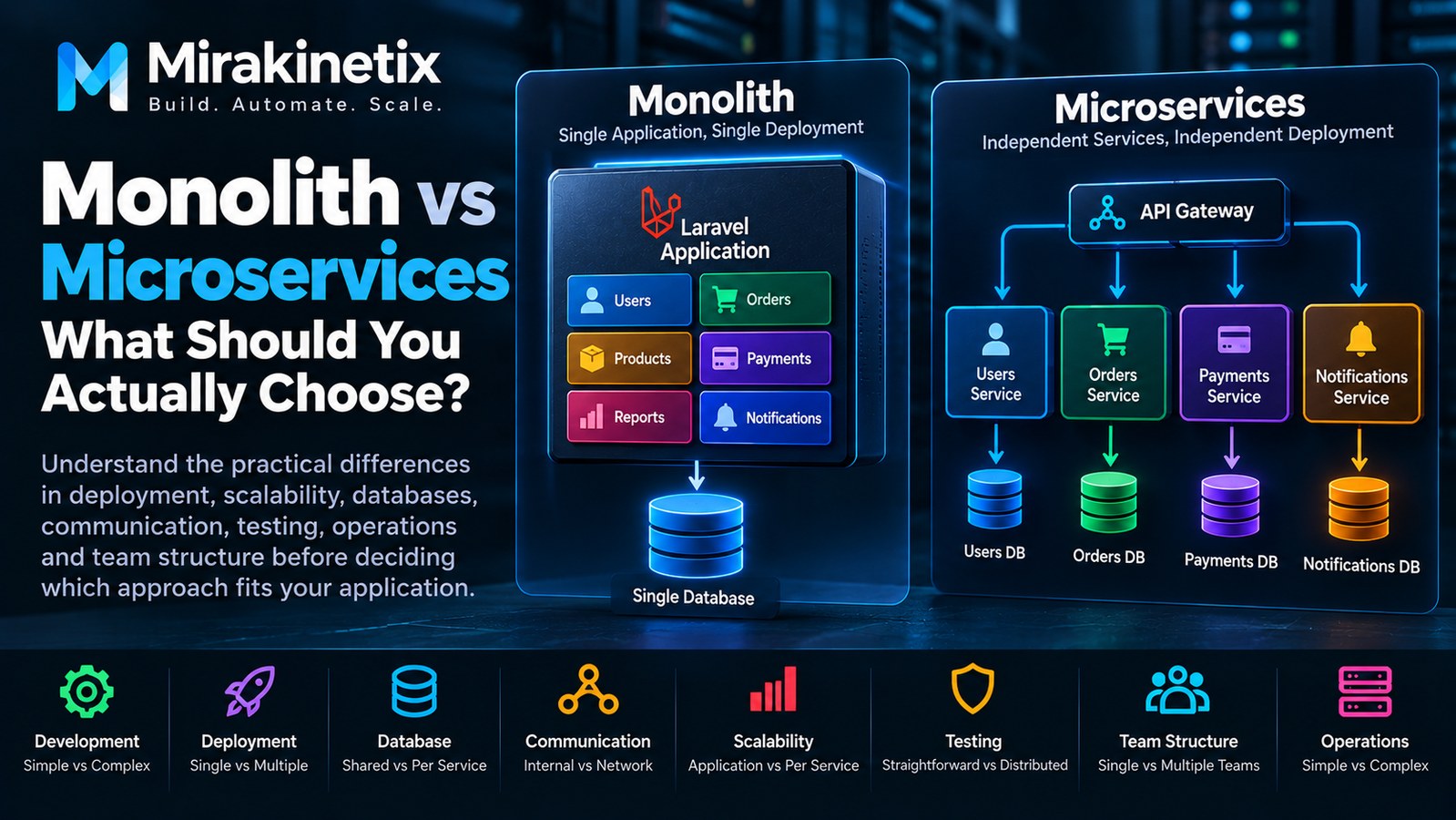
Monolith vs Microservices: What Should You Actually Choose?
"Microservices" has become one of the most frequently used terms in modern software architecture.
Many teams assume that a growing application should eventually be broken into dozens of independent services.
That is not necessarily true.
A well-designed monolith can be easier to develop, test, deploy, monitor, and maintain than a distributed system.
Microservices can provide important benefits, but they also introduce significant operational and architectural complexity.
The right question is not:
"Which architecture is more modern?"
The better question is:
"Which architecture fits the application's actual requirements?"
What Is a Monolith?
A monolithic application keeps most of its application functionality within a single deployable application.
A typical structure might look like:
                 Web Application
                       │
        ┌──────────────┼──────────────┐
        ↓              ↓              ↓
      Users          Orders         Reports
        │              │              │
        └──────────────┼──────────────┘
                       ↓
                    Database
A monolith does not necessarily mean poorly structured code.
A monolith can have:
Clear domain boundaries
Service classes
Modules
Dependency injection
APIs
Queues
Tests
Strong separation of responsibilities
The deployment model is what makes it monolithic, not the quality of its internal architecture.
What Are Microservices?
A microservices architecture divides an application into independently deployable services.
For example:
                  API Gateway
                       │
       ┌───────────────┼───────────────┐
       ↓               ↓               ↓
    Users           Orders          Payments
   Service          Service          Service
       │               │               │
    Database        Database        Database
Each service typically owns a specific business capability.
Services communicate through APIs, events, queues, or other messaging mechanisms.
The major difference is that each service can potentially be developed, deployed, scaled, and operated independently.
A Monolith Is Not Automatically Bad
A monolithic application can be an excellent architecture.
For a small or medium-sized product, a monolith may provide:
Simpler deployment
Easier debugging
Easier local development
Straightforward database transactions
Fewer network calls
Simpler testing
Lower infrastructure requirements
If a team can deploy one application reliably and it meets the business requirements, there may be little reason to introduce distributed-system complexity.
Microservices Are Not Automatically Better
Microservices solve certain problems, but they introduce others.
Instead of:
Application → Database
you may end up with:
Service A
   ↓
Service B
   ↓
Service C
   ↓
Service D
   ↓
Multiple Databases
Now you have to consider:
Network failures
Service discovery
API versioning
Distributed tracing
Message delivery
Authentication between services
Data consistency
Deployment coordination
Monitoring
Logging
Infrastructure automation
You have traded some application complexity for distributed-system complexity.
Deployment Is One of the Biggest Differences
With a monolith:
Code
 ↓
Build
 ↓
Test
 ↓
Deploy Application
With microservices:
Service A → Build → Test → Deploy
Service B → Build → Test → Deploy
Service C → Build → Test → Deploy
Service D → Build → Test → Deploy
Independent deployment can be extremely useful.
But every additional service also creates another deployment pipeline, configuration set, monitoring requirement, and operational responsibility.
The number of services should therefore be treated as an operational decision, not just a coding decision.
Communication Changes Everything
Inside a monolith, one component can generally call another directly within the same application process.
With microservices, communication often happens over a network.
For example:
Order Service
      │
      │ HTTP / API
      ↓
Payment Service
Network communication introduces new failure modes.
The payment service could be:
Slow
Unavailable
Overloaded
Returning an error
Returning an unexpected response
The calling service must handle those situations.
Distributed systems require developers to think about failure as a normal possibility.
Database Architecture Becomes More Complicated
A monolith commonly uses a shared database:
Application
     ↓
  MySQL
Microservices often move toward service-owned data:
Users Service  → Users DB

Orders Service → Orders DB

Payments       → Payments DB
This provides stronger service boundaries, but it creates new challenges.
For example, an operation that previously required one database transaction may now involve multiple services.
That makes consistency much harder.
Distributed Transactions Are Hard
Consider an order process:
Create Order
     ↓
Charge Payment
     ↓
Reserve Inventory
     ↓
Send Confirmation
In a monolith, these operations may be coordinated within one application and potentially one database transaction.
In a distributed architecture, they may involve multiple services.
What happens if:
Order created       ✓
Payment completed   ✓
Inventory failed    ✗
The architecture now needs a strategy for handling the partial failure.
This is one reason microservices should not be introduced casually.
APIs Become Contracts
Microservices depend heavily on APIs.
Once Service A depends on Service B, the API between them becomes a contract.
Changes need to be managed carefully.
For example:
Order Service
      │
      ↓
Payment API v1
Changing the payment API without considering existing consumers can break the order service.
API versioning, backward compatibility, documentation, and contract testing therefore become increasingly important.
Testing Gets More Complicated
Testing a monolith can be relatively straightforward.
You can run:
Unit Tests
     ↓
Feature Tests
     ↓
Integration Tests
     ↓
Application
Microservices require additional testing layers.
You may need:
Unit tests
Service-level integration tests
API tests
Contract tests
End-to-end tests
Event tests
Failure testing
The more services you introduce, the more combinations and failure scenarios you potentially need to test.
Debugging Requires Better Observability
In a monolith, a request may stay within one application.
With microservices:
User Request
    ↓
API Gateway
    ↓
Order Service
    ↓
Payment Service
    ↓
Inventory Service
If the request fails, which service caused the problem?
You need good observability to answer that.
Important capabilities include:
Centralized logs
Metrics
Distributed tracing
Correlation IDs
Error tracking
Health checks
Service-level monitoring
Without observability, distributed systems become extremely difficult to troubleshoot.
Scaling Is Different
A monolith can still scale horizontally:
Load Balancer
      ↓
App 1
App 2
App 3
You do not need microservices to have multiple application servers.
The advantage of microservices is that individual services can potentially be scaled independently.
For example:
Users Service      2 instances
Orders Service     5 instances
Search Service     10 instances
Reports Service    3 instances
This can be valuable when different workloads have dramatically different resource requirements.
Team Structure Matters
Architecture should also reflect how teams work.
A small team responsible for an entire application may find a large microservices architecture difficult to operate.
A larger organization with multiple teams working independently may benefit from clear service ownership.
For example:
Team A → Users
Team B → Orders
Team C → Payments
Team D → Search
Independent ownership can be a strong reason for service boundaries.
But creating services without clear ownership can simply create more operational work.
Choose Boundaries Around Business Capabilities
If you eventually introduce microservices, avoid splitting the application arbitrarily.
Do not start with:
UserController Service
OrderController Service
ProductController Service
simply because those classes exist.
Think in terms of business capabilities:
Identity
Orders
Payments
Inventory
Search
Notifications
A good service boundary should have a clear purpose and ownership.
A Concrete Laravel Decision Example
Consider a Laravel application for an online business.
Initially, it contains:
Laravel Application
│
├── Users
├── Products
├── Orders
├── Payments
├── Notifications
└── Reports
        │
        ↓
      MySQL
The application has one deployment, one primary database, and a small development team.
At this stage, there may be little reason to split it into microservices.
A modular Laravel monolith can provide clear boundaries while keeping deployment simple:
Laravel Application
│
├── Domains/
│   ├── Users/
│   ├── Products/
│   ├── Orders/
│   ├── Payments/
│   └── Reports/
│
└── MySQL
Each domain can have its own models, actions, services, policies, events, and tests.
Then the requirements change
Suppose the reporting workload becomes very heavy.
Generating reports consumes significant CPU and database resources and starts affecting normal order processing.
The first response does not have to be:
"Convert the entire Laravel application into microservices."
Instead, isolate the workload.
For example:
Laravel Application
      │
      ├── Orders
      ├── Users
      ├── Products
      └── Payments
              │
              ↓
           Queue
              │
              ↓
       Report Workers
The reporting jobs can run asynchronously and the workers can be scaled independently.
Later, another requirement appears
Suppose the payment system now needs:
Independent deployment
Separate security controls
Independent scaling
A dedicated engineering team
Integration with several external payment providers
Now extracting a Payment Service may become reasonable:
                    Laravel Application
                           │
                    Payment API
                           │
                           ↓
                    Payment Service
                           │
             ┌─────────────┼─────────────┐
             ↓             ↓             ↓
        Provider A    Provider B    Provider C
The important point is that the service was extracted because there was a concrete architectural requirement.
The team did not split Users, Products, Orders, and Reports simply because microservices were fashionable.
The decision path
The evolution might therefore look like:
Laravel Monolith
      ↓
Modular Laravel Architecture
      ↓
Queue Heavy Workloads
      ↓
Scale Web + Workers
      ↓
Identify Genuine Service Boundary
      ↓
Extract Payment Service
This is usually a more practical architectural journey than starting with twenty services on day one.
The Modular Monolith Is Often a Useful Middle Ground
A modular monolith keeps the application as one deployable unit while dividing its internal architecture into well-defined modules.
For example:
                Laravel Application
                       │
       ┌───────────────┼───────────────┐
       ↓               ↓               ↓
    Users           Orders          Payments
    Module          Module           Module
       │               │               │
       └───────────────┼───────────────┘
                       ↓
                    MySQL
Each module has clear responsibilities and interfaces.
This provides many benefits of good service boundaries without immediately introducing network communication and distributed deployment.
If a module eventually needs to become an independent service, having a clean boundary makes that transition easier.
Laravel Works Well as a Modular Monolith
Laravel provides several mechanisms that can support modular application architecture.
You can separate functionality using:
Domain modules
Services
Actions
Events
Jobs
Policies
Form Requests
API resources
For example:
app/
├── Domains/
│   ├── Users/
│   ├── Orders/
│   ├── Payments/
│   └── Inventory/
The exact structure depends on the application.
The important part is keeping responsibilities clear.
When Microservices Make Sense
Microservices may be appropriate when there is a genuine requirement for:
Independent deployment
Independent scaling
Strong service ownership
Different technology requirements
Large engineering teams
Clearly separated business capabilities
Isolation of specific workloads
Independent availability requirements
These are architectural requirements, not fashion statements.
When a Monolith Makes Sense
A monolith may be appropriate when:
The application is relatively small or medium-sized.
The team is small.
The domain is still evolving.
Deployment simplicity is important.
Most components share the same database.
The application does not have dramatically different scaling requirements.
Operational resources are limited.
A well-structured monolith can support substantial traffic.
Architecture should be driven by requirements and measurements rather than assumptions about scale.
A Practical Decision Framework
Before choosing microservices, ask:
Do we need independent deployments?
        ↓
Do different components need independent scaling?
        ↓
Do teams need independent ownership?
        ↓
Are the business boundaries well understood?
        ↓
Can we operate distributed infrastructure reliably?
        ↓
Is the additional complexity justified?
If the answer to most of these questions is no, a well-designed monolith or modular monolith may be sufficient.
A Practical Evolution Path
You do not need to decide the entire architecture on day one.
A practical path can be:
Simple Application
       ↓
Well-Structured Monolith
       ↓
Modular Monolith
       ↓
Identify Real Boundaries
       ↓
Extract Specific Services
       ↓
Operate as Distributed System
This allows architecture to evolve as actual requirements become clearer.
Instead of predicting every future problem, solve the problems you actually have.
Final Thoughts
The monolith-versus-microservices debate is often presented as a choice between old architecture and modern architecture.
That framing is misleading.
A monolith can be simple, scalable, and well engineered.
Microservices can provide independent deployment, scaling, and ownership, but they also introduce distributed-system complexity.
The most important architectural decision is therefore not choosing the most sophisticated architecture.
It is choosing an architecture that your team can build, test, deploy, monitor, secure, and operate reliably.
Start simple.
Keep boundaries clear.
Measure real problems.
Extract services when there is a genuine reason to do so.
Good architecture is not about having more services. It is about having the right boundaries for the problems you actually need to solve.


