
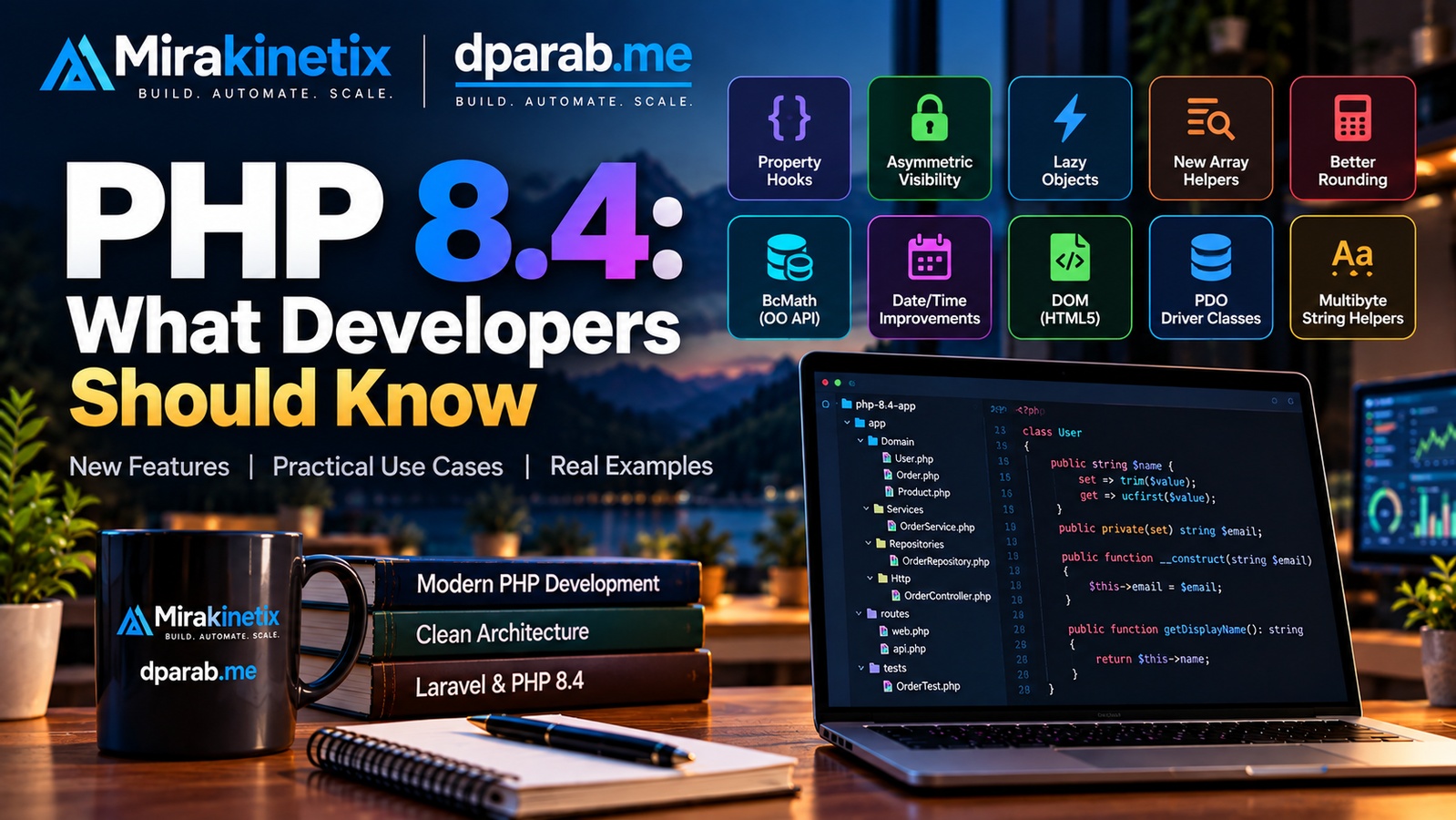
PHP 8.4 continues the modernization of PHP with new language features, better object handling, improved APIs, and developer-focused improvements.
For developers building applications with Laravel, Symfony, APIs, or custom PHP, the important question is not simply what changed. It is where these features are useful in real applications.
Here are the PHP 8.4 features worth understanding.
1. Property Hooks
Property hooks allow developers to define behavior when a property is read or written without creating traditional getter and setter methods.
class User
{
    public string $name {
        set => trim($value);
    }
}
Practical use case
Suppose usernames should never contain leading or trailing whitespace.
Instead of:
$user->setName(trim($name));
the property itself can enforce the rule.
This is useful for:
Data normalization
Value objects
Domain models
Validation-related transformations
Computed properties
Property hooks can reduce repetitive getter/setter code while keeping the behavior close to the property.
2. Asymmetric Property Visibility
PHP 8.4 allows reading and writing a property with different visibility.
class User
{
    public private(set) string $email;

    public function __construct(string $email)
    {
        $this->email = $email;
    }
}
The property can be read publicly but modified only from inside the class.
Practical use case
This is useful for objects where a value should be publicly readable but protected from arbitrary modification.
For example:
Order
 ├── id       → public read
 ├── status   → controlled write
 └── total    → controlled write
This can make domain objects safer without requiring a separate setter for every property.
3. Lazy Objects
PHP 8.4 introduces native lazy objects. Their initialization can be deferred until they are actually accessed.
Practical use case
Imagine an application with an expensive reporting service:
Request
   ↓
Create Report Service
   ↓
Load configuration
   ↓
Connect to data source
If the request does not actually generate a report, that work is unnecessary.
With lazy initialization:
Request
   ↓
Create Lazy Report Service
   ↓
Only initialize when used
This can be useful for expensive dependencies, large objects, framework infrastructure, and data that may not be needed during every request.
4. New Array Helper Functions
PHP 8.4 adds:
array_find()array_find_key()array_any()array_all()
For example:
$users = [
    ['name' => 'John', 'active' => false],
    ['name' => 'Mary', 'active' => true],
];

$user = array_find(
    $users,
    fn(array $user): bool => $user['active']
);
Practical use case
These functions are useful when processing collections of:
Users
Orders
Products
API responses
Configuration data
They can make simple collection searches and checks easier to read than manually writing foreach loops.
5. Better Rounding Control
PHP 8.4 adds the RoundingMode enum and additional rounding modes.
Practical use case
Financial, billing, tax, pricing, and measurement applications sometimes need explicit rounding behavior.
Instead of relying on a generic rounding assumption, the application can clearly specify the desired mode.
This makes business rules easier to understand and reduces ambiguity around calculations.
6. Object-Oriented BCMath
PHP 8.4 adds the BcMath\Number object for arbitrary-precision mathematics.
use BcMath\Number;

$total = new Number('123456789.12345');
$tax = new Number('18.50');

$result = $total * $tax;
Practical use case
This is useful when floating-point arithmetic is not appropriate, particularly for:
Financial calculations
Currency
High-precision measurements
Scientific calculations
The BCMath object API provides a more natural object-oriented way to work with arbitrary-precision numbers.
7. Improved Date and Time Handling
PHP 8.4 adds additional date/time capabilities, including creating DateTime objects from timestamps and working with microseconds.
Practical use case
Microsecond precision can be useful when recording:
API request timing
High-frequency events
Background jobs
Distributed-system events
Detailed application logs
For systems where multiple operations happen within the same second, higher timestamp precision can make debugging and event ordering easier.
8. Improved DOM and HTML5 Support
PHP 8.4 introduces a new DOM API with standards-compliant HTML5 parsing.
Practical use case
This can be useful for applications that need to process HTML programmatically.
Examples include:
Content processing
HTML sanitization workflows
Web scraping
Document transformation
CMS systems
Automated content analysis
For example, a content-processing system could parse an HTML document and find specific elements using modern DOM APIs.
9. Driver-Specific PDO Classes
PHP 8.4 introduces driver-specific PDO classes such as:
Pdo\MySql
Pdo\Pgsql
Pdo\Sqlite
Pdo\Odbc
Practical use case
Applications that use database-specific functionality can work with a more explicit database driver type.
This is particularly useful for libraries and applications that need to take advantage of driver-specific capabilities while still using PDO's database abstraction model.
10. Simpler Object Instantiation Syntax
PHP 8.4 allows method and property access directly after new without wrapping the expression in parentheses.
Previously:
(new User())->getName();
PHP 8.4:
new User()->getName();
Practical use case
This is primarily a syntax improvement.
It can make certain fluent expressions shorter, although it does not fundamentally change application architecture or performance.
11. Better Multibyte String Helpers
PHP 8.4 adds functions including:
mb_trim()
mb_ltrim()
mb_rtrim()
mb_ucfirst()
mb_lcfirst()
Practical use case
These are useful for applications that process multilingual text.
Examples include:
User-generated content
Internationalized applications
Search systems
CMS platforms
API data normalization
Using multibyte-aware functions is important when working with languages and character sets beyond simple ASCII text.
How These Features Fit Into a Laravel Application
A modern Laravel application can benefit from PHP 8.4 without using every feature.
For example:
Laravel
   ↓
Application Services
   ↓
Domain Objects
   ↓
Eloquent / Database
   ↓
MySQL
Property hooks and asymmetric visibility can be useful in domain objects.
New array helpers can simplify application-level collection processing.
Better date/time and numeric handling can help with business applications.
Lazy objects can be useful for framework and infrastructure components.
The important point is to use features where they improve the design rather than adopting them simply because they are new.
PHP 8.4 Production Upgrade Checklist
Before upgrading an existing application:
Verify framework compatibility
Check Composer dependencies
Review PHP 8.4 migration changes
Run automated tests
Test database integrations
Test queues and scheduled jobs
Test third-party APIs
Check production extensions
Review deprecated functionality
Test staging before production
PHP's official migration guide specifically recommends testing compatibility before moving an application to PHP 8.4.
Final Thoughts
PHP 8.4 is not about one feature that changes everything.
Its value comes from a collection of improvements that make modern PHP development cleaner and more expressive.
Property hooks can reduce repetitive property logic.
Asymmetric visibility can protect object state.
Lazy objects can defer expensive initialization.
Array helpers can simplify collection processing.
Improved rounding and BCMath help with precise calculations.
Date/time improvements provide better timestamp handling.
DOM improvements strengthen HTML processing.
PDO improvements provide clearer driver-specific APIs.
The best approach is practical: understand the features, identify where they solve real problems, and introduce them gradually into applications where they provide measurable value.
Modern PHP is not about using every new feature. It is about using the right features to build cleaner, safer, and more maintainable software.


