
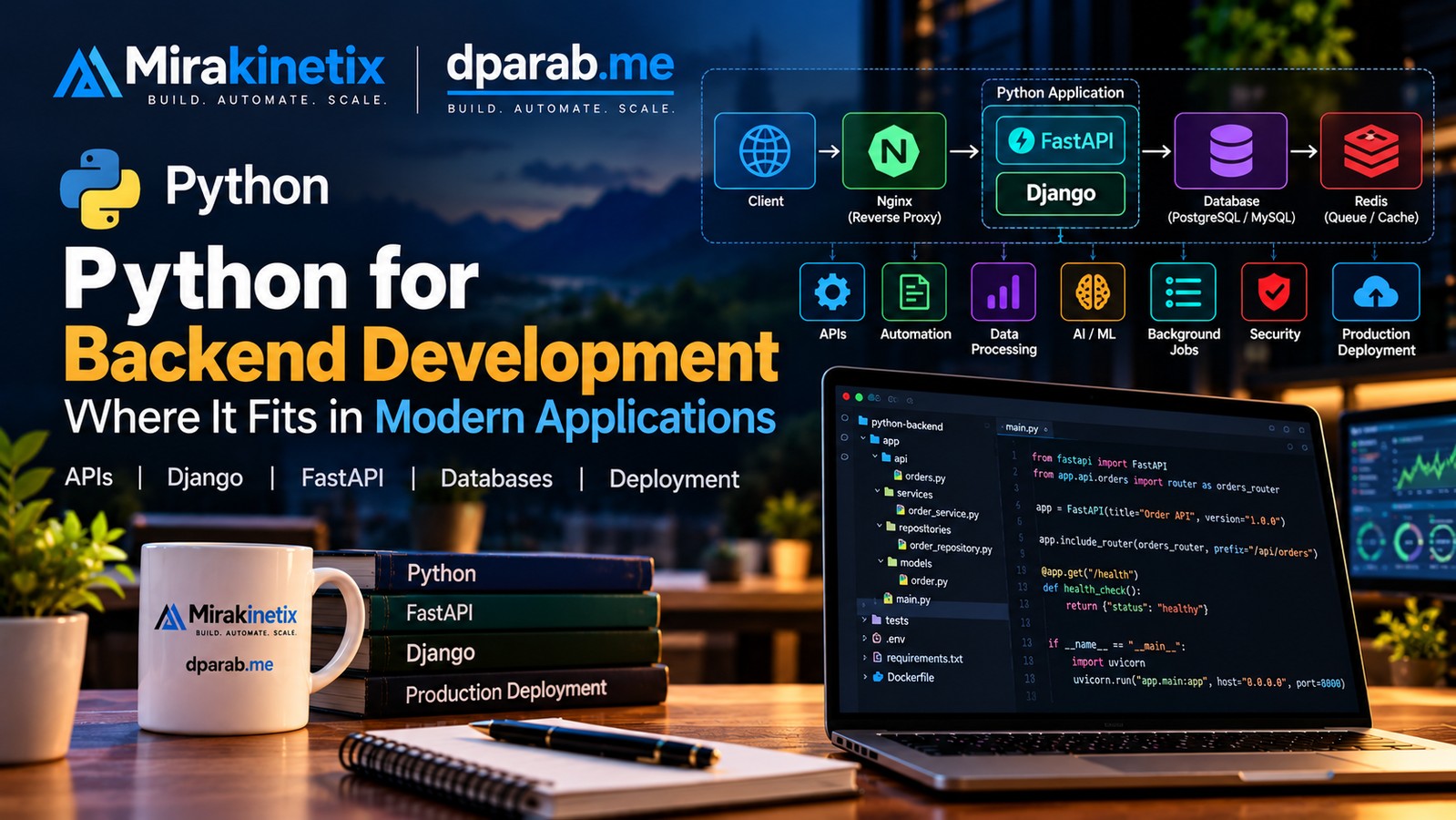
Python has become an important backend development language. It is used for APIs, automation, data processing, machine learning, AI applications, internal tools, and business systems.
Its simple syntax and large ecosystem make Python productive for developers. But choosing Python for a backend application should still be based on the application's requirements rather than popularity alone.
Where Python Fits
Python is particularly useful when an application needs:
REST APIs
Automation
Data processing
AI or machine learning integration
Background jobs
Internal business applications
Rapid development and prototyping
Python can also be used for larger production systems when the architecture and operational practices are designed appropriately.
Django vs FastAPI
Two popular approaches to Python backend development are Django and FastAPI.
Django
Django is a full-featured web framework that provides many components needed for traditional web applications.
It includes features such as:
URL routing
Authentication
Database integration
Admin interface
Forms
Security features
Django can be a strong choice when an application needs a comprehensive framework rather than assembling many individual components.
FastAPI
FastAPI focuses heavily on API development.
A simple API endpoint can look like:
from fastapi import FastAPI

app = FastAPI()

@app.get("/orders/{order_id}")
def get_order(order_id: int):
    return {
        "order_id": order_id,
        "status": "processing"
    }
FastAPI also provides automatic API documentation and works well with Python's type-hinting capabilities.
The choice between Django and FastAPI should depend on the application's requirements.
A Practical Backend Structure
A Python API can follow a structure similar to:
Request
   ↓
API Route
   ↓
Service
   ↓
Repository
   ↓
Database
For example:
app/
├── api/
│   └── orders.py
├── services/
│   └── order_service.py
├── repositories/
│   └── order_repository.py
├── models/
│   └── order.py
└── main.py
The exact structure can vary, but separating responsibilities prevents business logic from becoming concentrated inside API endpoints.
Python and Databases
Python applications can work with databases such as:
MySQL
PostgreSQL
SQLite
MongoDB
Database performance still matters regardless of programming language.
Important areas include:
Proper indexes
Query optimization
Connection pooling
Transactions
Pagination
Avoiding unnecessary queries
A fast Python application can still become slow if every request performs inefficient database operations.
Python for Background Processing
Some operations should not block an API request.
Examples include:
Sending emails
Generating reports
Processing uploaded files
Image processing
Data imports
Calling slow external services
These tasks can be moved into background workers.
A typical architecture might look like:
API
 ↓
Queue
 ↓
Worker
 ↓
Database / External Service
This allows the API to respond quickly while longer operations run asynchronously.
Python and AI
One of Python's biggest advantages is its ecosystem around data science and AI.
A backend application can combine a Python API with AI services:
Client
   ↓
Python API
   ↓
AI Service
   ↓
Database
This makes Python particularly useful for applications that combine traditional backend functionality with machine learning or AI capabilities.
However, AI functionality should still be treated as a component of the overall system. Authentication, authorization, rate limiting, logging, monitoring, and data protection remain important.
Error Handling
Production APIs should return predictable errors rather than exposing internal exceptions.
For example:
{
    "error": "ORDER_NOT_FOUND",
    "message": "The requested order was not found"
}
Applications should also log enough information to investigate failures without exposing sensitive data.
Configuration and Secrets
Do not hard-code passwords or API keys in Python source files.
Production configuration should come from environment-specific configuration or a secure secrets-management solution.
For example:
DATABASE_URL
REDIS_URL
API_KEY
Secrets should never be committed to Git.
Security
Python applications need the same security discipline as applications built with any other backend language.
Important areas include:
Authentication
Authorization
Input validation
Secure password storage
SQL injection prevention
HTTPS
Rate limiting
Dependency security
Secure file uploads
Secrets management
Using a framework does not automatically make an application secure.
Testing
A production Python application should have automated tests appropriate to its complexity.
Useful test levels include:
Unit Tests
    ↓
Integration Tests
    ↓
API Tests
    ↓
End-to-End Tests
Tests are especially valuable when an application contains important business rules or is being developed by multiple engineers.
Production Deployment
A production deployment should be repeatable rather than dependent on manual commands.
A typical deployment flow can be:
Git
 ↓
Install Dependencies
 ↓
Run Tests
 ↓
Build / Package
 ↓
Deploy
 ↓
Health Check
 ↓
Monitor
For a FastAPI application, an application server such as Uvicorn can serve the Python application, while a reverse proxy can handle HTTPS and incoming traffic.
A simple production architecture might look like:
Internet
   ↓
Nginx / Load Balancer
   ↓
Python Application
   ↓
Database
   ↓
Redis / Queue
For larger systems, multiple application instances can run behind a load balancer.
Production deployments should also consider:
Environment-specific configuration
Process management
HTTPS
Database migrations
Application logs
Health checks
Monitoring
Backups
Rollback procedures
The deployment method should match the application's size. A small application does not automatically need Kubernetes or a complex container platform.
Monitoring Python Applications
Production monitoring should cover both the application and its infrastructure.
Useful metrics include:
Request rate
Response time
Error rate
CPU usage
Memory usage
Database performance
Queue depth
Worker failures
Logs and metrics should make it possible to determine what happened when a production problem occurs.
When Python Makes Sense
Python can be a strong choice when development speed, automation, data processing, or AI integration are important requirements.
It can be particularly attractive for systems where the backend needs to interact with data-processing or machine-learning components.
However, technology choice should consider the entire system:
Team expertise
Performance requirements
Existing infrastructure
Library ecosystem
Operational requirements
Long-term maintenance
Practical Python Backend Checklist
Architecture
Clear separation of API, service, and data-access layers
Business logic kept outside route handlers
Appropriate framework selected
Database
Proper indexes
Efficient queries
Connection management
Transaction strategy
Security
Authentication and authorization
Input validation
Secrets protected
Dependencies reviewed
Rate limiting where appropriate
Operations
Structured logging
Health checks
Application metrics
Error monitoring
Background jobs monitored
Deployment
Automated tests
Repeatable builds
Environment-specific configuration
HTTPS configured
Database migrations handled safely
Rollback strategy
Final Thoughts
Python is more than a scripting language. It can serve as the foundation for APIs, business applications, automation platforms, data-processing systems, and AI-enabled applications.
Frameworks such as Django and FastAPI provide different approaches to building Python backends, but the framework is only one part of the solution.
Good architecture, database design, security, testing, logging, monitoring, and deployment practices determine whether a Python application remains maintainable as it grows.
Choose Python when its ecosystem and strengths match the problem—not simply because it is popular.


