
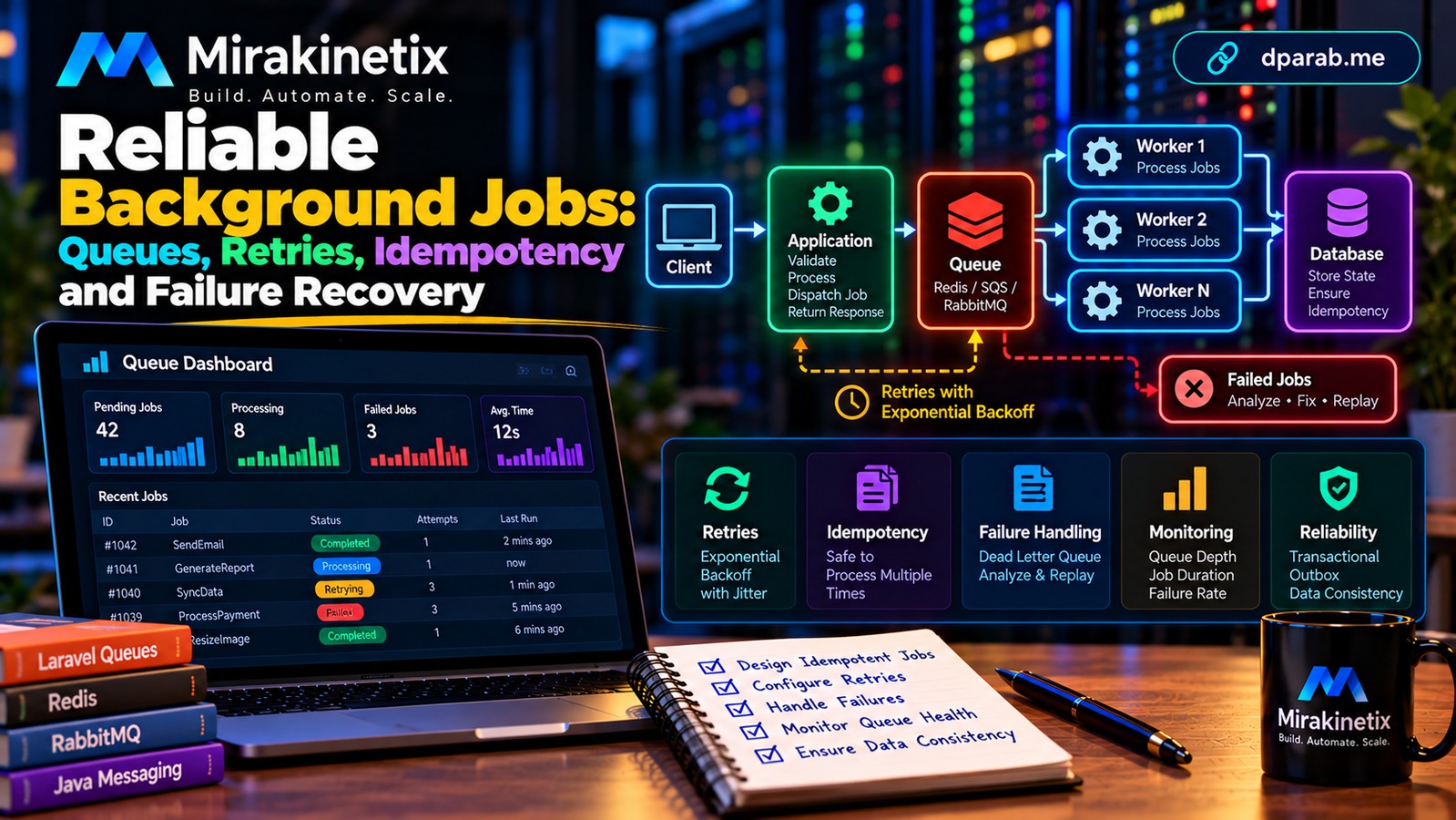
A background job can fail after completing half its work. A worker can crash after an external API accepts a request but before the application records the result. A queue can deliver the same message more than once.
These are not unusual edge cases. They are normal failure scenarios in distributed applications.
Background processing improves responsiveness by moving slow or nonessential work outside the main request cycle. However, adding a queue does not automatically make an application reliable. Developers must design for retries, duplicate execution, partial failures, monitoring, and recovery.
For backend developers, senior engineers, and technical leads, the goal is simple: make background work recoverable, observable, and safe to execute more than once.
1. Identify Work That Belongs in a Queue
A background job is useful when work does not need to finish before the user receives a response.
Common examples include:
Sending email and notifications.
Generating large reports.
Processing uploaded documents.
Synchronizing external systems.
Importing large datasets.
Resizing images.
Running scheduled maintenance.
Processing webhook events.
For example, an API that generates a large PDF should not necessarily keep the HTTP request open until the report is ready.
A better flow is:
Client → API → Validate request → Dispatch job → Return job ID → Worker generates report → Client retrieves status or result
The API remains responsive, and the worker can scale independently.
However, do not move every operation into a queue. Authentication, essential validation, and immediate business decisions may need to happen synchronously.
2. Understand Delivery Guarantees
A queue system may provide different delivery semantics depending on its implementation and configuration.
At-most-once delivery avoids repeated delivery but may lose work under certain failure conditions.
At-least-once delivery allows redelivery when acknowledgement or completion cannot be confirmed. This improves recoverability but means duplicates are possible.
Exactly-once processing across a database and an external service is difficult without additional coordination. A queue's delivery guarantee does not automatically guarantee exactly-once business effects.
Design important jobs to tolerate repeated execution rather than assuming every message arrives exactly once.
3. Make Jobs Idempotent
An operation is idempotent when repeating it produces the same intended final effect as executing it once.
Consider a payment-processing job. If a worker times out after a payment provider processes the transaction, the application may not know whether the payment succeeded.
Blindly retrying the payment could charge the customer twice.
A safer design uses a stable business operation ID and, where supported, the provider's idempotency key. The application also records processing state and verifies the outcome before attempting another charge.
For database operations, enforce uniqueness with database constraints where appropriate. Application-level checks alone may fail when two workers process the same operation concurrently.
For example, an import job can use a unique external record ID so repeated deliveries update or recognize the same record instead of inserting duplicates.
Important: a boolean such as processed = true is not sufficient for every workflow. Consider concurrent workers, interrupted transactions, and the possibility that an external side effect succeeded before local state was updated.
4. Configure Retries and Backoff Carefully
Some failures are temporary:
Network timeouts.
Rate limits.
Temporary service unavailability.
Database connection interruptions.
Other failures are permanent, such as invalid input or a missing required business record.
Retrying permanent failures wastes resources and creates noise.
Use bounded retries with increasing delays, often called exponential backoff. Add jitter when appropriate to prevent many workers from retrying simultaneously.
For example:
First retry after a short delay.
Second retry after a longer delay.
Subsequent retries with progressively longer intervals.
Stop after the configured limit and move the job into a failure-handling workflow.
Respect external API rate-limit instructions where available. Avoid immediate retry loops, and make sure job timeouts, visibility timeouts, and worker termination settings are compatible.
A job that repeatedly fails should become visible to operators rather than retry forever.
5. Laravel Example: A Queueable Job
Laravel provides queue support for moving work into background workers.
A simplified job might look like this:
<?php

namespace App\Jobs;

use App\Models\Report;
use Illuminate\Contracts\Queue\ShouldQueue;
use Illuminate\Foundation\Queue\Queueable;

class GenerateReport implements ShouldQueue
{
    use Queueable;

    public int $tries = 3;

    public function __construct(
        public int $reportId
    ) {}

    public function handle(): void
    {
        $report = Report::findOrFail($this->reportId);

        if ($report->status === 'completed') {
            return;
        }

        // Generate the report and persist its result.
        // Ensure repeated execution is safe.
    }
}
Dispatch it after validating the request:
GenerateReport::dispatch($report->id);This example illustrates the structure, not a complete idempotency implementation. In production, protect state transitions against concurrent execution, record failures, and ensure that generated files or external effects cannot create inconsistent results when a job is retried.
Configure the queue connection, worker process management, timeout, retry policy, and failed-job handling for your actual workload.
6. Java Example: Queue Processing
The same principles apply to Java applications using Spring Boot and a message broker.
A consumer might receive a report-generation message and delegate it to a service:
public void process(ReportJob job) {
    if (reportRepository.isCompleted(job.reportId())) {
        return;
    }

    reportService.generate(job.reportId());
}
The simplified check must be backed by appropriate concurrency controls and durable state. Two consumers could otherwise pass the check at the same time.
For important workflows, consider database uniqueness constraints, transactional state changes, message acknowledgement behavior, and broker-specific redelivery policies.
The framework and broker can manage message transport, but the application must still define what successful business processing means.
7. Prevent Lost Work With the Transactional Outbox Pattern
A common failure occurs when an application updates a database and publishes a queue message as two separate operations.
Suppose an order is saved successfully, but publishing the notification message fails. The order exists, yet the notification job was never created.
The transactional outbox pattern addresses this problem by writing both the business change and an outbox record in the same database transaction.
A separate publisher reads pending outbox records and publishes them to the message broker. It marks records as published after successful delivery, with recovery logic for interrupted publishing.
The publisher may send the same event more than once, so consumers still need idempotency.
The outbox pattern is particularly valuable for order processing, payment workflows, event-driven integrations, and other operations where losing an event would create inconsistent systems.
8. Handle Failed Jobs and Recovery
A reliable system must answer three questions:
How do we detect failed work?
How do we determine why it failed?
How do we safely recover it?
Record useful job identifiers, attempt counts, timestamps, error categories, and correlation IDs. Avoid placing credentials or sensitive payloads in failure logs.
Separate transient failures from permanent business failures. Provide controlled replay or reprocessing procedures and ensure operators can determine whether an external side effect already occurred.
Before replaying a failed payment or financial operation, verify its actual status. For a report-generation job, regeneration may be safe if output publication is atomic and repeated execution is controlled.
Failure recovery should be a designed workflow, not an improvised production command.
9. Monitor Queue Health
A queue can be technically operational while falling behind.
Monitor:
Queue depth and oldest message age.
Job processing duration.
Success and failure rates.
Retry counts.
Worker availability and utilization.
Dead-letter or failed-job volume.
External dependency latency.
Time from job submission to completion.
Queue depth alone is not enough. A small queue containing jobs that have been waiting for an hour may be more concerning than a large queue processed quickly by healthy workers.
Define alerts around service objectives. For example, if report jobs must finish within five minutes, alert when queue age indicates that the deadline is at risk.
Scale workers according to throughput and downstream capacity. Adding workers will not solve a saturated database or an external API rate limit.
10. A Practical Reliability Checklist
Before deploying a background-processing workflow, verify that:
Jobs have clear inputs and ownership.
Retries are bounded and delayed appropriately.
Duplicate execution is safe.
Database state transitions are concurrency-safe.
External side effects use idempotency controls where supported.
Timeouts and acknowledgements are configured correctly.
Failed jobs are observable and recoverable.
Queue backlogs trigger actionable alerts.
Sensitive information is excluded from logs.
Important database changes and events cannot silently diverge.
Final Thoughts
Queues make applications more responsive, but reliable background processing requires more than dispatching jobs and starting workers.
Delivery semantics, idempotency, retry policies, transactional consistency, failure recovery, and monitoring must work together. A well-designed system expects interruptions and can recover without duplicating business effects or losing important work.
Start with one critical workflow, document its failure modes, test retries and worker crashes, and expand the same discipline across the application.
Mirakinetix helps businesses build, automate, and scale reliable software systems. Visit dparab.me for practical engineering insights and Mirakinetix for software architecture, automation, performance optimization, and application security.
Build. Automate. Scale.


