
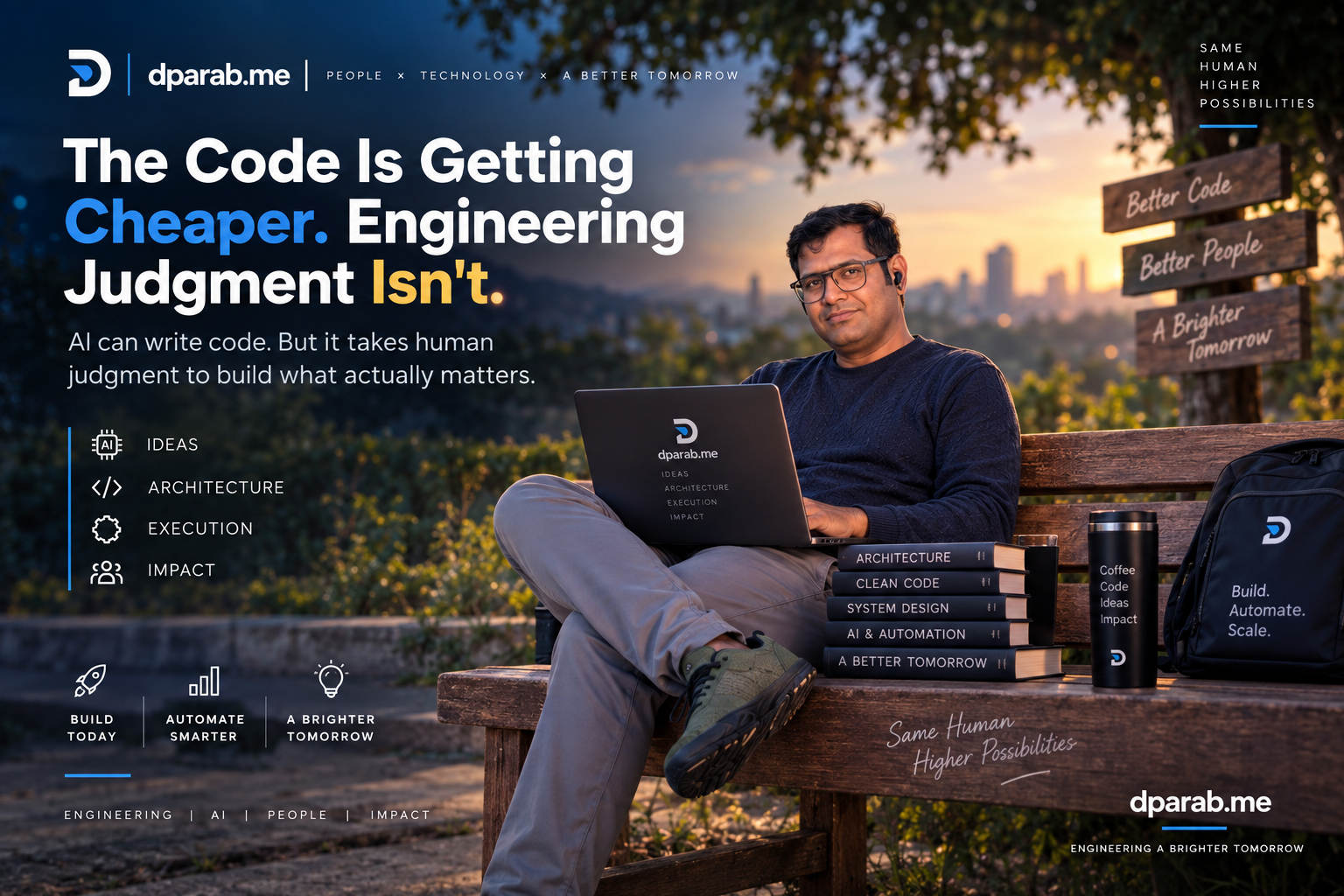
The Code Is Getting Cheaper. Engineering Judgment Isn't.
AI has changed the economics of software development.
Code can now be generated in seconds. Boilerplate that once took hours can be produced almost instantly. Developers can prototype ideas, write tests, generate documentation, refactor code, and explore unfamiliar technologies faster than ever.
That sounds like the value of software engineering should be declining.
I don't think it is.
I think something more interesting is happening:
The cost of producing code is falling.
The value of knowing what code should exist is rising.
Code Generation Is Becoming a Commodity
For decades, software development involved a significant amount of manual implementation.
Developers wrote repetitive CRUD operations, configuration files, API clients, validation logic, tests, migrations, UI components, and integration code.
AI can now accelerate much of that work.
The result is an enormous increase in the amount of code that can be produced.
But more code does not automatically mean better software.
A system can contain thousands of perfectly valid lines of code and still be fundamentally wrong.
That is where engineering judgment matters.
Software Engineering Is Bigger Than Writing Code
A production system is not simply a collection of functions.
Someone still has to answer questions such as:
What should we build?
What should we not build?
Where should this logic live?
What happens when traffic increases?
What happens when the database becomes the bottleneck?
What happens when an external API fails?
What data should we store?
How should authentication and authorization work?
What happens when a deployment goes wrong?
How do we recover?
What should be logged?
What should be monitored?
Where are the security boundaries?
AI can help answer these questions.
But someone still needs to understand the consequences of the answers.
That is engineering.
Architecture Becomes More Important, Not Less
When implementation becomes faster, architectural mistakes become cheaper to create and more expensive to discover later.
A developer can ask an AI system to generate a feature in minutes.
But if the feature is built on the wrong abstraction, the wrong database model, or the wrong integration boundary, the resulting technical debt can spread rapidly.
AI accelerates implementation.
It can therefore accelerate bad architecture too.
Good engineers understand the difference.
They don't simply ask:
"Can we build this?"
They ask:
"Should we build this this way?"
Security Doesn't Disappear Because AI Wrote the Code
AI-generated code still needs security review.
Authentication, authorization, input validation, secrets management, dependency security, file handling, database access, session management, API security, and privilege boundaries remain engineering responsibilities.
A generated application can look convincing while containing serious vulnerabilities.
The danger is not that AI cannot write secure code.
The danger is assuming that generated code is secure because it looks professional.
Security requires adversarial thinking.
Someone has to think like the person trying to break the system.
Performance Still Has Physics
AI can generate a database query.
It cannot repeal database fundamentals.
Indexes still matter.
Query plans still matter.
Network latency still matters.
Memory still matters.
Concurrency still matters.
Caching still has trade-offs.
Queues still need workers.
Horizontal scaling still introduces complexity.
A beautifully generated application can still collapse under production load.
Performance engineering requires understanding how systems behave, not simply how code is written.
Testing Becomes More Important
When developers can produce more code faster, the surface area that needs testing grows.
AI can generate tests.
That is useful.
But tests can also encode incorrect assumptions.
A test that passes does not prove that the underlying requirement is correct.
Good engineering requires testing:
Behaviour
Failure modes
Boundaries
Security assumptions
Data integrity
Real-world scenarios
The question is not simply:
"Did the tests pass?"
It is:
"Are we testing the things that actually matter?"
The New Skill: Engineering With AI
The most valuable engineers will not necessarily be the ones who write the most code manually.
They will be the ones who can effectively collaborate with AI.
That means being able to:
Define problems clearly.
Provide useful context.
Design architecture before implementation.
Review generated code critically.
Identify incorrect assumptions.
Challenge AI-generated solutions.
Validate security and performance.
Test edge cases.
Understand the underlying technologies.
Know when to accept a generated solution.
Know when to reject it.
AI becomes a force multiplier.
But a force multiplier is only useful when the person directing it understands the force.
The Junior-to-Senior Difference May Become More Visible
There is an interesting consequence of AI-assisted development.
Some of the traditional difference between junior and senior developers came from implementation speed and accumulated knowledge.
AI reduces some of that gap.
A junior developer can now generate sophisticated-looking code.
But that does not automatically give them senior-level judgment.
The ability to recognize a bad abstraction, a dangerous security decision, a scaling problem, or an unnecessary architectural complication still requires experience.
In fact, AI may make this distinction more visible.
When everyone can generate code, judgment becomes the differentiator.
Knowing What Not to Build
One of the most underrated engineering skills is knowing when not to build something.
Every feature has a cost.
Every dependency adds complexity.
Every service introduces operational responsibility.
Every database table becomes part of your data model.
Every API becomes a contract.
Every background job needs monitoring.
Every additional abstraction needs maintenance.
AI makes it extremely easy to say:
"Let's build it."
Experienced engineers are often the people who say:
"We don't need it."
That can save more money than writing the feature faster.
The Future Engineer
The future of software engineering is not humans versus AI.
It is:
Engineers who use AI effectively versus engineers who don't.
But the winning engineer will not be the person who delegates everything to AI.
The winning engineer will be the person who can:
Direct AI
Verify its output
Understand its limitations
Challenge its assumptions
Take responsibility for the final system
That requires fundamentals:
Architecture.
Databases.
Security.
Performance.
Testing.
Operations.
Product thinking.
Communication.
Judgment.
AI can make implementation dramatically faster.
It cannot take responsibility for the system.
That responsibility still belongs to the engineer.
The Bottom Line
The code is getting cheaper.
Engineering judgment isn't.
Devdutt Parab
Software Engineering • Architecture • AI • Technology


