
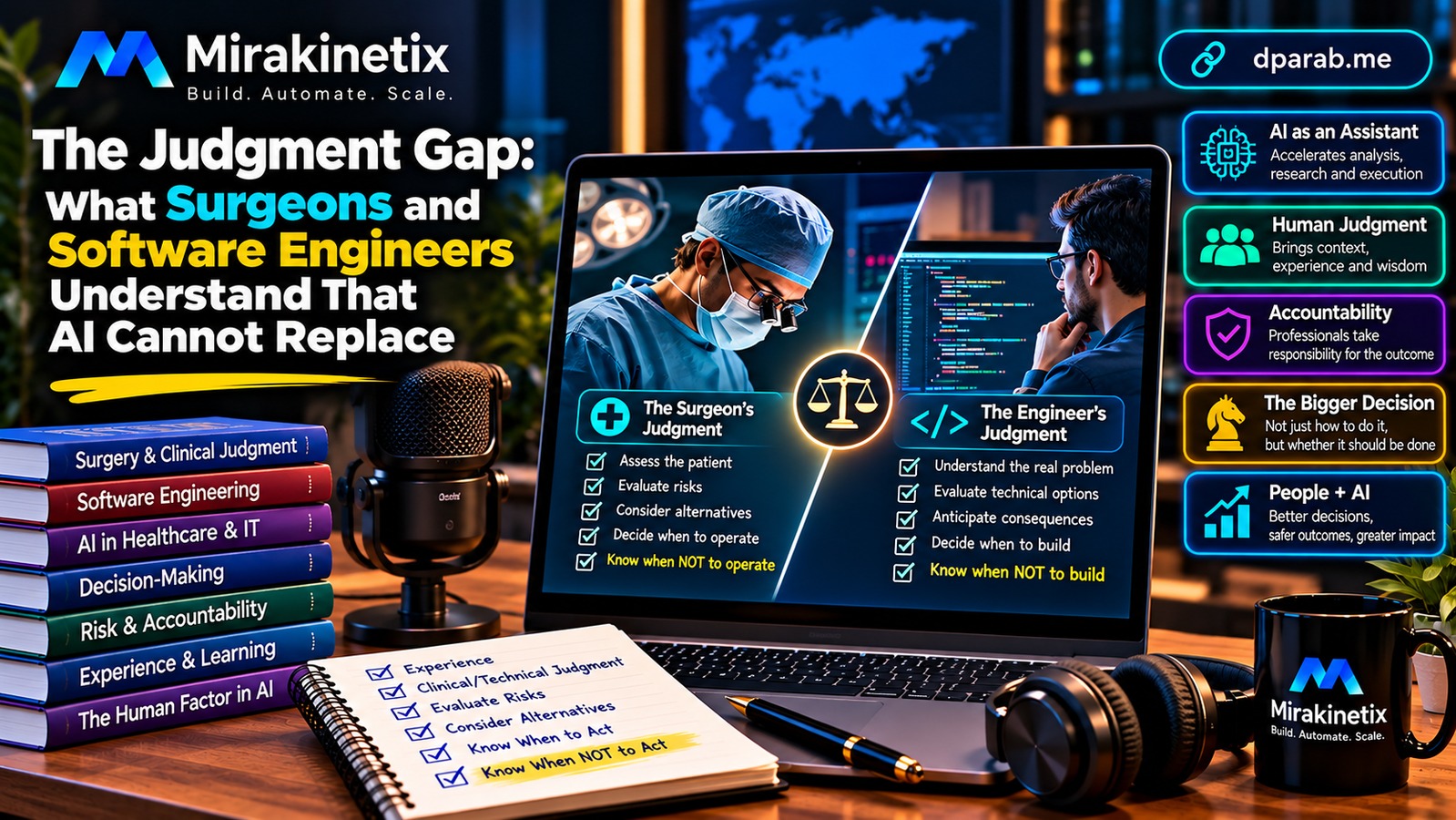
Knowing how to perform a task is a skill. Knowing whether it should be performed at all is judgment.
Artificial intelligence is changing almost every profession. It can write software, analyse documents, generate reports, assist with research and automate tasks that previously required years of training and considerable human effort.
In software engineering, AI can generate code, suggest architectures, identify bugs and help developers build applications faster.
In medicine, AI can assist with medical imaging, analyse clinical information and support doctors in evaluating possible diagnoses.
These developments are remarkable. But they also raise an important question:
When machines become increasingly capable of performing professional tasks, what happens to the value of human experience?
I believe the answer becomes clearer when we look at two professions that might initially seem very different: surgery and software engineering.
Both require technical knowledge. Both involve complex decisions. Both carry consequences when things go wrong.
And both demonstrate why professional expertise is about considerably more than the ability to execute a task.
1. A surgeon's expertise goes far beyond the operating table
When we think about an experienced surgeon, we often imagine the operating theatre.
We think about precision, steady hands, technical knowledge and the ability to perform complicated procedures.
But these are only visible parts of surgical expertise.
A surgeon's work begins long before an operation.
They must understand the patient's medical history, evaluate symptoms, interpret investigations, consider alternative treatments, assess surgical risks and determine whether an operation is necessary.
They must also consider the patient's overall condition, potential complications, recovery prospects and the consequences of different treatment options.
And sometimes, after evaluating everything, the surgeon may decide not to operate.
That decision is important.
Knowing how to perform an operation is one aspect of being a surgeon. Knowing when that operation is necessary, when it should be delayed, when another treatment is preferable and when its risks outweigh its benefits requires a different level of professional judgment.
An experienced surgeon does not approach every patient with the assumption that surgery is the answer.
They approach every patient with the responsibility of finding the most appropriate course of treatment.
The ability to operate is a technical skill. The judgment to decide whether to operate is a much broader professional responsibility.
This distinction is at the heart of what experience brings to medicine.
2. The operating theatre is not a place for blind confidence
Surgery involves uncertainty.
Even when investigations are available and a procedure is planned carefully, the human body does not always behave exactly as expected.
A surgeon may encounter unexpected findings, complications or circumstances that require a change in approach.
Years of clinical experience help develop the ability to recognise warning signs, evaluate changing situations and respond appropriately.
This is not simply about memorising medical procedures.
It is about combining clinical knowledge with observation, experience, reasoning and accountability.
A surgeon must understand not only what can be done, but also what could happen as a consequence of doing it.
And importantly, confidence must not become overconfidence.
An experienced professional knows that every intervention carries some degree of risk. Good judgment involves understanding those risks rather than ignoring them.
This is one reason why clinical experience cannot be reduced to the number of operations performed or the number of years spent in a hospital.
It also involves the decisions made before, during and after those operations.
3. An experienced software engineer faces a similar responsibility
Now consider software engineering.
An experienced engineer is not simply someone who can write code quickly or work with a large number of programming languages.
Years of practical experience expose engineers to situations that cannot always be understood through documentation or tutorials.
Production failures, database corruption, security vulnerabilities, performance bottlenecks, failed migrations, architectural mistakes and difficult maintenance decisions all contribute to professional learning.
Eventually, an experienced engineer starts looking beyond the immediate development task.
When someone proposes a new feature, the engineer may ask whether it is actually necessary.
When someone recommends rewriting an application, the engineer may first investigate whether the existing system can be improved.
When an AI tool suggests introducing a new framework or architecture, the engineer evaluates whether the additional complexity is justified.
The questions become different:
What problem are we actually solving?
What happens if this implementation fails?
Could this change affect existing users or data?
What are the long-term maintenance implications?
Are we introducing unnecessary complexity?
Is there a simpler and safer alternative?
And sometimes, the engineer's recommendation is not to build anything.
That is not a lack of ambition or technical ability.
It is engineering judgment.
Just as a surgeon does not recommend an operation merely because it can be performed, an experienced engineer should not recommend a technical change merely because it can be implemented.
4. Both professions understand the consequences of intervention
This is where the comparison becomes particularly interesting.
A surgical intervention changes something in a patient's body. A software intervention changes something in a system that people and organisations depend on.
The consequences are different, and the two professions should never be treated as equivalent in their responsibilities or risks.
However, both require professionals to think beyond the immediate action.
A surgeon considers the risks of an operation, possible complications and the patient's recovery.
An engineer considers the impact of a deployment, data integrity, system availability, security and the long-term consequences of an architectural decision.
Consider a few examples from engineering.
Rewriting an existing application
A new architecture may look attractive. But a complete rewrite can introduce new defects, migration risks, unexpected costs and operational disruption.
The experienced engineer asks whether the expected benefits justify those risks.
Changing a production database
A database modification may appear straightforward. But what happens to existing records? Has the migration been tested? Is there a rollback strategy? What happens if the operation is interrupted?
The engineer understands that a successful SQL statement is not the same as a safe production change.
Introducing automation
Automating a process may save time. But what happens when the automation encounters an unexpected condition? Can it make irreversible changes? Is there sufficient monitoring and human oversight?
The right question is not simply whether automation is possible.
It is whether automation is appropriate and safe.
In all these situations, technical capability is only one part of the decision.
5. Experience is accumulated through failures, difficult cases and responsibility
One thing both professions share is that meaningful experience is not developed entirely through successful outcomes.
A surgeon learns through years of clinical practice, difficult cases, unexpected complications, discussions with colleagues and continuous learning.
An engineer develops through successful projects, production incidents, technical mistakes, difficult migrations and the responsibility of maintaining systems that people depend on.
There is a difference between knowing a procedure from a textbook and understanding the practical challenges of performing it.
Likewise, there is a difference between knowing how to write an application and understanding what happens when that application runs in production for years.
Experience changes the way professionals think.
They become more cautious about assumptions. They recognise patterns earlier. They understand that decisions have consequences beyond the immediate task.
They also become more comfortable saying, "I don't know," seeking another opinion or reconsidering an earlier decision.
That is not weakness.
It is professional maturity.
6. What happens when AI enters the operating theatre and the development environment?
AI is already becoming an important supporting technology in medicine and software engineering.
In healthcare, AI can assist with image analysis, information retrieval, documentation and clinical decision support.
In software engineering, AI can generate code, explain unfamiliar systems, suggest fixes, analyse errors and accelerate development.
These capabilities can be extremely useful.
But there is an important distinction between providing information and taking professional responsibility for a decision.
Imagine an AI system analysing a patient's information and suggesting a possible treatment approach.
The suggestion may be useful, but a qualified medical professional must evaluate it against the patient's actual condition, medical history, examination findings and clinical circumstances.
Similarly, imagine an AI assistant generating a database migration or suggesting a new application architecture.
The output may be technically convincing. But an experienced engineer must examine its assumptions, test its behaviour and evaluate its impact on the actual system.
In both situations, the professional must retain the ability to question the recommendation.
AI can support the decision-making process. It should not become an excuse to abandon professional reasoning.
A recommendation is not the same as a decision. And generating a solution is not the same as taking responsibility for it.
7. The danger of confusing speed with expertise
One of the biggest changes introduced by AI is the speed at which professional-looking output can be produced.
A developer can generate hundreds of lines of code in a short time.
A report can be prepared in minutes.
Information can be summarised almost instantly.
But faster output does not automatically mean better outcomes.
In software engineering, generated code may work in a demonstration but fail under production conditions. It may introduce security weaknesses or overlook important business requirements.
In medicine, AI-generated information may assist a doctor, but it cannot automatically account for every clinical detail or replace the responsibility of evaluating an individual patient.
The danger is not the technology itself.
The danger is accepting output without understanding its limitations.
We should be particularly careful not to confuse the ability to produce an answer with the ability to evaluate whether that answer is appropriate.
The more accessible execution becomes, the more important professional judgment becomes.
8. What should we value in the next generation of professionals?
If AI can perform an increasing number of technical and administrative tasks, professional development must go beyond learning how to use the latest tools.
Future doctors will need to understand how to use AI while strengthening clinical reasoning, patient communication and ethical responsibility.
Future engineers will need to understand how to use AI while developing deeper knowledge of architecture, security, databases, performance and system reliability.
Across professions, several qualities will remain essential:
Knowledge: Understanding the fundamentals rather than depending entirely on tools.
Experience: Learning from successes, failures and difficult situations.
Critical thinking: Questioning recommendations and evaluating evidence.
Judgment: Understanding which course of action is appropriate in a particular situation.
Accountability: Accepting responsibility for decisions and their consequences.
Restraint: Recognising when an intervention is unnecessary or potentially harmful.
These qualities cannot be replaced simply by making tools faster.
9. The most important decision may sometimes be to do nothing
This is perhaps the most important connection between surgery and engineering.
A surgeon may decide that an operation is not the best option for a patient.
An engineer may decide that a stable application does not need a complete rewrite.
A doctor may recommend monitoring rather than immediate intervention when clinically appropriate.
An engineer may recommend observing a system and gathering more evidence before changing production infrastructure.
These decisions can be difficult because professionals are often expected to demonstrate action.
We celebrate operations performed, features delivered, applications launched and problems apparently solved.
But preventing an unnecessary intervention can be just as valuable as successfully completing one.
Sometimes the best professional decision is to wait, investigate further, seek another opinion or avoid introducing additional risk.
The ability to recognise that moment is a sign of experience.
Final thoughts: Expertise is the wisdom behind the action
I started thinking about this connection after reflecting on a discussion about the experience and judgment of surgeons.
It made me reconsider something I have observed throughout my own 18 years in IT.
The most valuable engineers are not necessarily those who write the most code, use the newest frameworks or implement every proposed feature.
They are often the people who understand the consequences of a decision before it is made.
Likewise, a surgeon's expertise cannot be measured simply by the number of procedures performed. It also lies in clinical judgment, the ability to assess risks and the wisdom to recognise when an operation should not be performed.
The two professions are different, but they share an important principle: expertise involves much more than execution.
AI will continue to change how doctors, engineers and other professionals work. We should welcome the opportunities it creates.
But we must not lose sight of what makes professional experience valuable.
Machines can help generate recommendations, analyse information and execute tasks.
Professionals must still question, evaluate and take responsibility.
A surgeon's greatness is not measured only by the operations performed. An engineer's greatness is not measured only by the systems built.
It is also measured by the complications prevented, the risks avoided, the unnecessary interventions rejected and the decisions made with sound judgment.
And perhaps this is the most important lesson for the AI era:
The future will not just need people who know how to do more. It will need people who understand when doing less is the wiser decision.


