
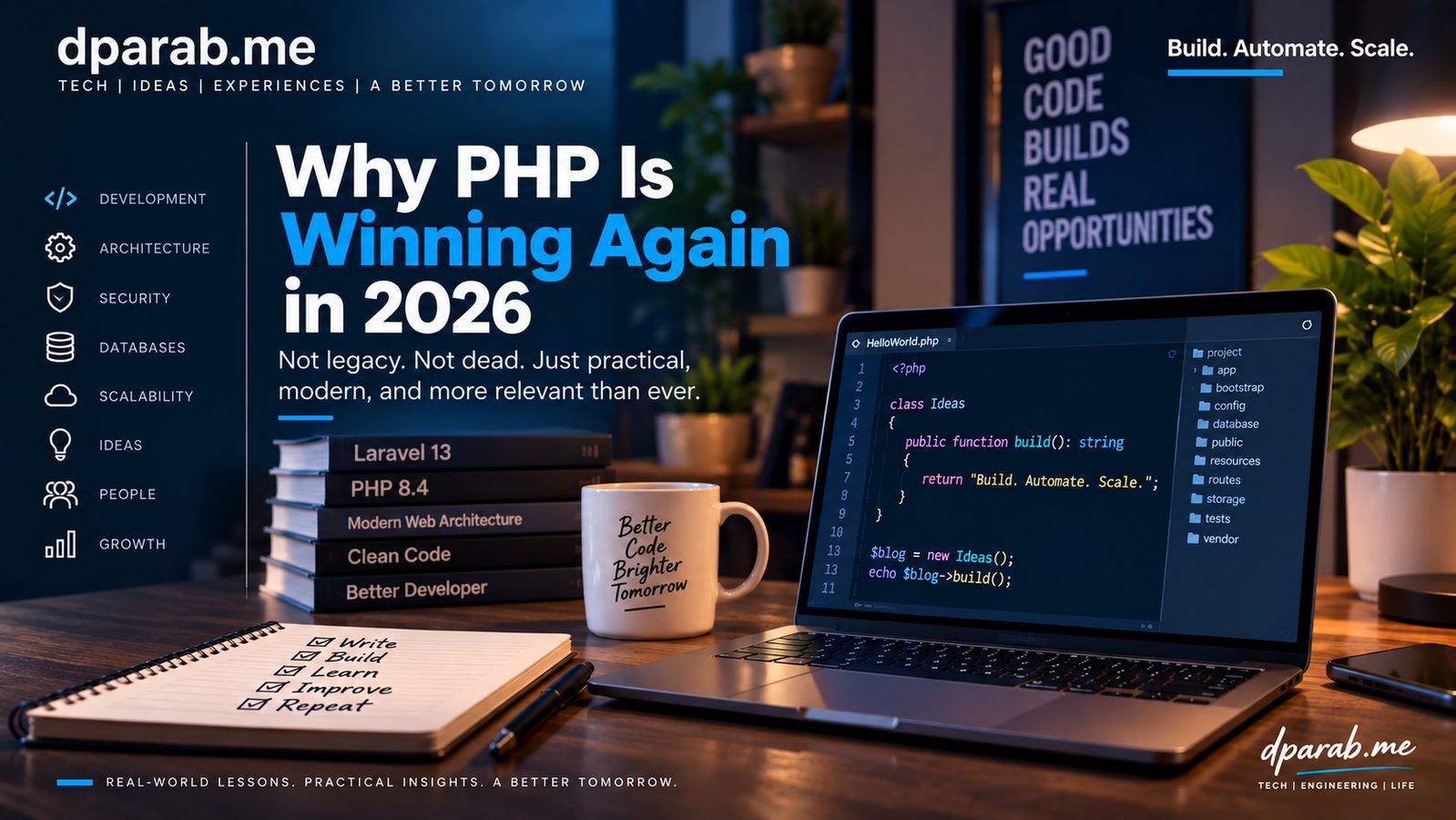
PHP has been declared dead more times than most programming languages have been declared successful.
Yet in 2026, PHP is still powering millions of websites and applications, while modern frameworks such as Laravel continue to attract developers building serious production systems.
The interesting question is not whether PHP survived.
It is why PHP remains relevant when developers have so many alternatives.
The answer is surprisingly simple:
PHP became practical.
It evolved without abandoning the enormous ecosystem that already existed around it.
PHP Is No Longer the PHP Many Developers Remember
A lot of the criticism surrounding PHP comes from experiences with older versions of the language.
That criticism was understandable.
Older PHP codebases could contain inconsistent APIs, weak typing, procedural code, global state, poor architecture, and security problems caused by inexperienced development practices.
Modern PHP is a very different environment.
With PHP 8.x, developers have access to features such as strong type declarations, attributes, enums, constructor property promotion, union types, named arguments, readonly properties, improved error handling, and significantly better performance.
The language has matured.
More importantly, the ecosystem around it has matured.
Today, building a PHP application does not mean throwing scripts into a web directory and hoping for the best.
You can build structured applications with dependency injection, automated testing, queues, caching, API layers, background workers, authentication systems, observability, and deployment pipelines.
That is a completely different development experience.
Laravel Changed the Conversation
One of the biggest reasons modern PHP remains relevant is Laravel.
Laravel gives developers a productive application framework without forcing them to sacrifice architectural flexibility.
Routing, middleware, authentication, validation, queues, events, caching, database abstraction, notifications, scheduled tasks, testing, and API development are all part of a coherent ecosystem.
That matters.
Developers spend enormous amounts of time assembling infrastructure before they can actually build a product.
A productive framework reduces that friction.
Laravel allows an engineer to start with a simple application and gradually introduce more sophisticated architecture as the requirements grow.
That is an important characteristic.
Not every application needs microservices on day one.
Sometimes a well-designed modular monolith is exactly what the business needs.
Productivity Is an Engineering Advantage
There is sometimes a strange assumption that choosing a more complicated technology automatically means building a better system.
It doesn't.
Complexity has a cost.
Every additional service introduces another deployment boundary, another monitoring requirement, another failure mode, another set of credentials, and another operational responsibility.
A technology stack that allows a small engineering team to build and operate a system efficiently can be a significant competitive advantage.
This is where PHP continues to perform well.
A developer can move from an idea to a working application quickly.
A team can maintain the system without requiring a large platform engineering department.
And a business can continue investing in the product instead of continuously rebuilding its infrastructure.
That is not old-fashioned engineering.
That is pragmatic engineering.
The Database Still Matters
Modern applications are increasingly discussed in terms of APIs, AI, cloud infrastructure, containers, and distributed systems.
But underneath many of those systems is still a database.
Someone still needs to design tables.
Someone needs to understand indexes.
Someone needs to investigate slow queries.
Someone needs to understand transactions and locking.
Someone needs to determine whether a performance problem is caused by the application, database, network, or infrastructure.
PHP works particularly well in this environment because its ecosystem has always had strong database integration.
But the important point is not that PHP can connect to MySQL.
Almost every serious language can.
The important point is that PHP applications can be designed around sound database architecture without requiring unnecessary infrastructure.
Good engineering still starts with understanding the workload.
PHP Is Well Suited to the Web
PHP's biggest advantage may also be the one developers overlook.
It was designed for the web.
That history created an enormous ecosystem of hosting providers, libraries, frameworks, developers, deployment tools, monitoring solutions, CMS platforms, and business applications.
There is infrastructure everywhere.
There are developers everywhere.
There is documentation everywhere.
There are existing applications everywhere.
This creates a powerful network effect.
A technology does not need to be fashionable to be useful.
It needs to solve problems reliably.
The Cost of Infrastructure Matters
There is another reason PHP remains attractive in 2026:
Infrastructure cost matters.
Not every business is building a global social network.
A large number of applications are internal platforms, SaaS products, business portals, ecommerce systems, content platforms, dashboards, APIs, automation systems, and customer-facing web applications.
Many of these applications can be operated effectively using a relatively straightforward architecture.
A Linux server.
Nginx or Apache.
PHP-FPM.
A database.
Redis when needed.
Queues when needed.
Object storage when needed.
That architecture may not sound exciting.
But boring infrastructure is often good infrastructure.
If it is secure, observable, maintainable, scalable enough for the workload, and inexpensive to operate, it is doing its job.
AI Makes Good Engineering More Important
There is an interesting twist in 2026.
AI can generate PHP code extremely quickly.
That might appear to reduce the value of PHP developers.
I believe the opposite is happening.
When generating code becomes cheaper, understanding systems becomes more valuable.
An AI system can generate a controller.
It can generate a migration.
It can write an API endpoint.
It can suggest an SQL query.
But someone still needs to determine whether the resulting system is actually correct.
Does the database design make sense?
Are authorization rules enforced?
Can the endpoint be abused?
Will the query work with ten million records?
What happens when Redis is unavailable?
What happens when the queue backs up?
What happens during deployment?
What happens when two requests modify the same record simultaneously?
Those are engineering questions.
They do not disappear because code generation became faster.
PHP Is Becoming More of an Engineering Platform
The future of PHP is therefore not about writing more PHP code.
It is about using PHP as part of a broader engineering system.
A modern Laravel application can interact with:
Redis
MySQL
PostgreSQL
MongoDB
queues
WebSockets
external APIs
object storage
search engines
analytics platforms
AI services
background workers
containerized infrastructure
The language becomes one component of the architecture.
That is exactly where a mature technology should be.
Performance Is About Architecture
Another misconception is that PHP applications cannot scale.
Poorly designed PHP applications cannot scale.
Neither can poorly designed applications written in any other language.
Performance is rarely solved simply by changing programming languages.
It starts with architecture.
Database indexes.
Query design.
Caching.
Connection management.
Queue architecture.
HTTP caching.
CDNs.
Efficient application code.
Horizontal scaling.
Load balancing.
Observability.
Capacity planning.
A well-designed PHP application can scale significantly when the architecture is appropriate for the workload.
And when it reaches the point where the architecture needs to evolve, the application can evolve with it.
The Real Advantage Is Boring
There is nothing particularly glamorous about choosing a technology because it is mature, well understood, widely supported, and productive.
But engineering is not a popularity contest.
Businesses need systems that work.
They need systems that can be maintained.
They need developers who can understand the code.
They need infrastructure that can be operated.
They need security.
They need predictable costs.
And they need the ability to ship products.
PHP continues to satisfy those requirements surprisingly well.
The Future Is Not About Choosing One Language
The technology industry often frames development as a competition.
PHP versus Node.js.
PHP versus Python.
PHP versus Go.
PHP versus Java.
That framing is usually less useful than it appears.
Modern systems are increasingly polyglot.
A Laravel application might communicate with Python services.
A PHP backend might use a Node.js WebSocket service.
An application might use Go for a specialized high-throughput component.
AI workloads may run in completely different environments.
The important question is not:
"Which language wins?"
The better question is:
"Which technology solves this particular problem effectively?"
For a large class of web applications, PHP remains a very strong answer.
PHP Does Not Need to Be Cool
PHP does not need another comeback story.
It never really left.
The language evolved.
The frameworks evolved.
The tooling evolved.
The developers evolved.
And the problems being solved with PHP became more sophisticated.
In 2026, the strongest argument for PHP is not nostalgia.
It is practicality.
You can build quickly.
You can build cleanly.
You can build securely.
You can integrate with modern infrastructure.
You can scale when the workload demands it.
And you can operate the resulting system without turning every application into a distributed-systems research project.
That combination is difficult to dismiss.
Final Thought
Technology trends come and go.
Architectural fashions change.
New languages appear.
Old languages are declared dead.
But software engineering ultimately comes back to a few simple questions:
Can we build it?
Can we maintain it?
Can we secure it?
Can we scale it when necessary?
Can we operate it reliably?
Can we afford to run it?
In 2026, PHP still has very good answers to those questions.
PHP isn't winning because it is the newest technology.
It is winning because it remains useful.


