
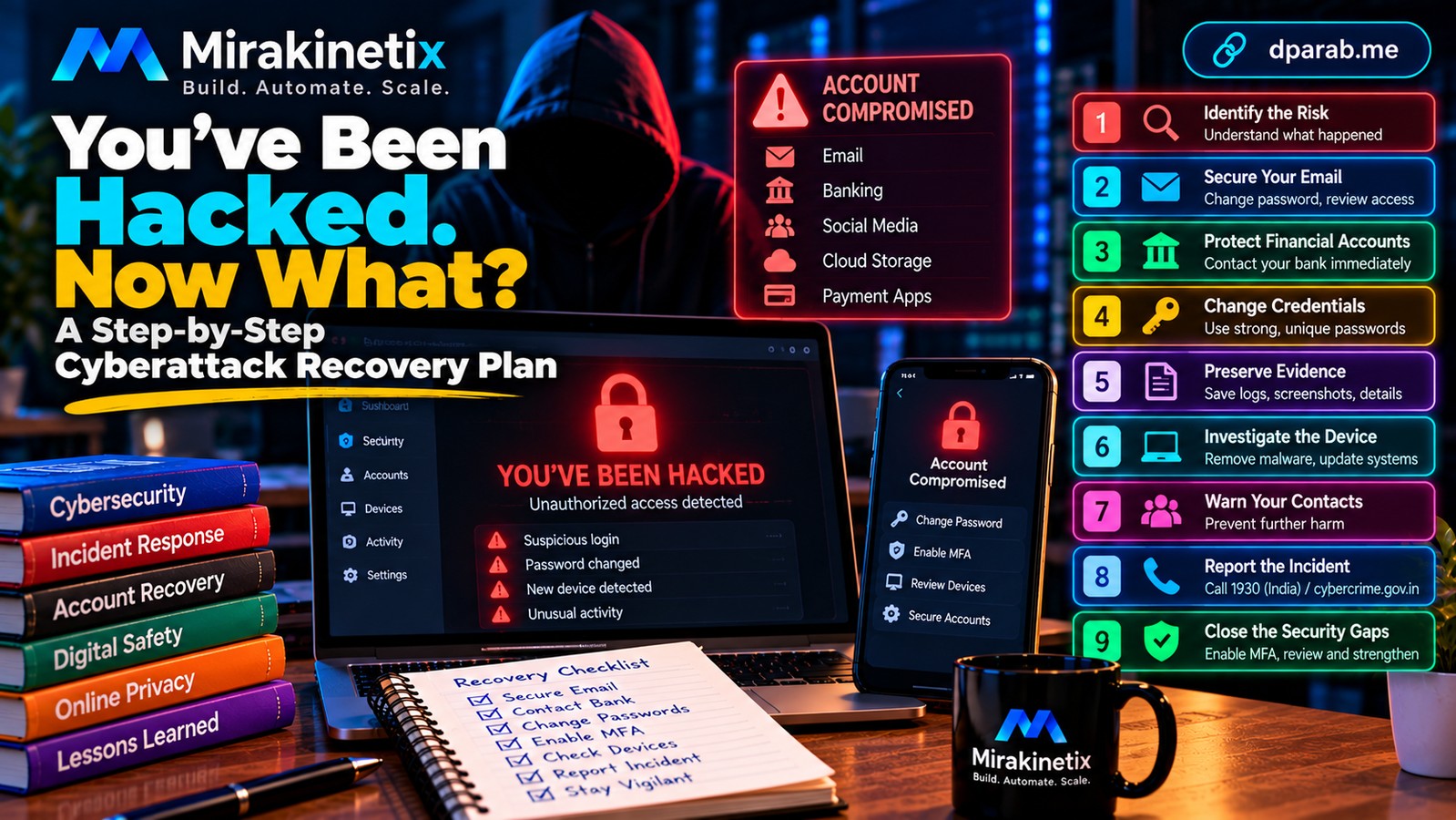
When Prevention Fails, Your Response Matters
You receive an unfamiliar login alert. Your email password no longer works. A friend tells you that your social media account is sending suspicious messages. Or you notice a financial transaction you never authorized.
These are moments when panic can lead to mistakes.
A cyberattack does not automatically mean every account and device has been compromised. Your priority is to identify what may be affected, contain the incident, protect critical accounts, preserve evidence, and recover methodically.
Here is a practical recovery plan you can follow.
Step 1: Identify the Immediate Risk
Start by identifying what appears to have happened.
Has an online account been compromised?
Has money been transferred without authorization?
Did you install an unfamiliar application?
Are files being encrypted or deleted?
Has someone gained access to your email or phone number?
Is someone threatening to publish stolen information?
The answer determines your next move.
If you suspect financial fraud, contact your bank immediately. In India, call the national cybercrime helpline at 1930 as quickly as possible and report the incident through https://cybercrime.gov.in.
If you suspect active malware or unauthorized remote control, disconnect the affected device from networks when appropriate and safe to do so. Do not use a potentially compromised device to change passwords for other accounts.
Step 2: Secure Your Primary Email Account
Email is often the recovery mechanism for other services, making it a priority when compromised.
From a trusted device:
Change the password to a unique, strong one.
Sign out unfamiliar sessions and revoke suspicious access.
Check recovery email addresses and phone numbers.
Inspect forwarding rules, filters, and connected applications.
Enable multi-factor authentication or passkeys where supported.
If you cannot regain access, use the provider's official recovery process.
A password change alone may not be enough. Attackers may have modified recovery settings or created forwarding rules to maintain access, so review these carefully.
Step 3: Protect Your Financial Accounts
If banking or payment access may be compromised, contact your bank or payment provider through its official application, website, or verified telephone number.
Explain what happened and request appropriate protective action. Depending on the circumstances, this may include blocking a card, restricting access, disputing a transaction, or securing a compromised payment account.
Preserve transaction IDs, timestamps, recipient details, and complaint reference numbers.
Do not assume that changing a password automatically reverses a payment or stops every type of fraudulent transaction. Follow your provider's incident-response instructions.
Step 4: Change Compromised Credentials
Change exposed passwords from a trusted device, starting with critical accounts.
If you reused the compromised password, replace it everywhere it was used. Review recovery settings, revoke suspicious sessions, and remove unfamiliar connected applications.
Avoid rushing through dozens of password changes on a device that may still be infected. Secure the device first or use another trusted device.
Step 5: Preserve Evidence
Evidence may be important for a bank dispute, platform investigation, police complaint, or insurance claim.
Preserve:
Suspicious emails and messages.
Screenshots of security alerts and unauthorized activity.
Transaction references and timestamps.
Relevant phone numbers, website addresses, and account identifiers.
Complaint numbers and correspondence with service providers.
Avoid deleting everything immediately. Do not reopen malicious attachments or forward them to others to collect evidence.
For serious business incidents or ransomware attacks, seek professional incident-response assistance before wiping devices or reinstalling systems.
Step 6: Investigate the Affected Device
If you suspect malware, stop using the device for banking and other sensitive activities until it has been assessed.
Use trusted security tools where appropriate and seek qualified assistance if the compromise persists. For serious incidents, preserve forensic evidence before wiping or rebuilding the system.
If you decide to reset or reinstall a device, use official installation sources, install security updates, and restore only backups you trust.
A factory reset is not a universal solution. It does not automatically secure compromised online accounts or eliminate unauthorized access through recovery mechanisms.
Step 7: Warn People Who May Be Targeted
Attackers may use compromised accounts to send fraudulent messages to contacts.
Notify friends, colleagues, or customers through a separate communication channel. Explain that suspicious requests from the affected account should not be trusted.
If your account is being used to request money, make that warning explicit.
For a business, follow the organization's incident-response and communication procedures.
Step 8: Report the Incident
In India, the National Cyber Crime Reporting Portal is available at https://cybercrime.gov.in.
For suspected financial cyber fraud, call 1930 promptly. Also contact your bank or payment provider and follow its reporting process.
If identity documents have been misused, ask the relevant issuing organization or affected service provider about its official reporting and protective procedures.
Keep a record of complaint numbers, dates, and instructions received.
Reporting promptly may help authorities and financial institutions take action, but it does not guarantee recovery of lost money.
Step 9: Close the Security Gaps
After containing the incident, determine how it happened.
Was a password reused? Did a malicious application receive excessive permissions? Was a recovery email outdated? Did someone approve a fraudulent request?
Address the underlying weakness instead of relying solely on a password change.
Enable multi-factor authentication, update devices, revoke unnecessary access, strengthen backups, and educate affected users where appropriate.
Final Thoughts
Cybersecurity is not about pretending that attacks will never happen. It is about reducing the likelihood of compromise and limiting the damage when something goes wrong.
Remember the sequence:
Contain the threat. Secure critical accounts. Protect your money. Preserve evidence. Report the incident. Recover methodically.
A calm, structured response can make a significant difference when every minute matters.


